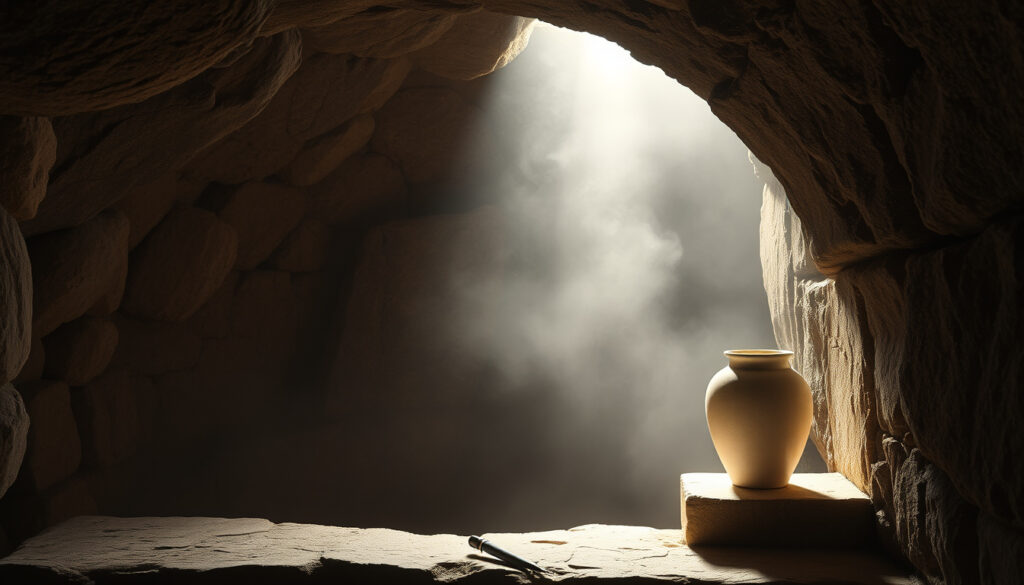
Mary Magdalene: Biography, Myths and Facts
For centuries, the name Mary Magdalene has sparked a mix of reverence and scandal. But the woman behind the legends is far more interesting than the myths suggest. A careful look at the New Testament and early Christian sources reveals a devoted disciple who was the first to witness the resurrection — and who never, in any biblical text, is called a prostitute.
Mentions in canonical gospels: 12 times ·
First witness of the Resurrection: Yes (John 20:11-18) ·
Feast day: July 22 ·
Patron saint of: sinners, penitents, women, contemplatives ·
Popular misidentification: Prostitute (debunked by most scholars)
Quick snapshot
- She was a Jewish follower of Jesus from Magdala (Smithsonian Magazine (history publication))
- She was present at the crucifixion and burial (Britannica (reference encyclopedia))
- She was the first witness to the resurrection, per John 20 (National Geographic (science & history publisher))
- She is not identified as a prostitute in any canonical gospel (FutureChurch (Catholic reform organization))
- Whether she was married or had a romantic relationship with Jesus (Vatican News (official Vatican media))
- Her activities after the resurrection (Acts does not mention her) (Smithsonian Magazine)
- The exact location of her tomb (Britannica)
- The historicity of the Gospel of Mary Magdalene (gnostic text) (Vatican News)
- c. 1st century AD: Born in Magdala (Britannica)
- c. 30 AD: First witness of the resurrection (Vatican News)
- 591 AD: Pope Gregory the Great conflates her with the sinful woman of Luke 7 (National Geographic)
- 1969: Catholic Church formally corrects the misidentification (Vatican News)
- 2016: Pope Francis elevates her feast day to a major celebration (Catholic Preaching (theological commentary))
- Continued scholarly work on the Gospel of Mary and other gnostic texts (Smithsonian Magazine)
- Growing public awareness of the historical Mary through popular media (National Geographic)
- Potential further corrections in liturgical materials across denominations (Vatican News)
Seven key facts about Mary Magdalene, one pattern: she was far more than a supporting character — she was a primary witness and leader.
| Label | Value |
|---|---|
| Full name | Mary of Magdala |
| Birthplace | Magdala, Galilee (modern-day Israel) |
| Era | 1st century AD |
| Primary sources | Canonical gospels (Matthew, Mark, Luke, John) |
| Feast day | July 22 |
| Patronage | Sinners, penitents, women, contemplatives, pharmacists |
| Symbols | Alabaster jar, red egg, skull |
What is Mary Magdalene known for?
Role in the Gospels
- Mary Magdalene is identified in the New Testament as a follower of Jesus and a supporter of his ministry (Britannica (reference encyclopedia)).
- Luke associates Mary Magdalene with other women who were healed of evil spirits, including an account that seven demons had gone out of her (Britannica).
- She appears in all four canonical Gospels at or around the resurrection accounts (Smithsonian Magazine (history publication)).
Her presence across the Gospels is consistent: she is always named among the women who traveled with Jesus, provided financial support, and stayed through the darkest hours. The implication: she was not a marginal figure but a core member of the movement.
Witness to the Crucifixion and Resurrection
- The canonical Gospels present Mary Magdalene as present at the crucifixion, burial, and resurrection narratives (Smithsonian Magazine).
- In John’s Gospel, Mary Magdalene is the first person to see the risen Jesus (Smithsonian Magazine).
- The Vatican describes her as the first among the women to proclaim Jesus had overcome death (Vatican News (official Vatican media)).
Why this matters: Being the first witness to the resurrection gave her a foundational role in early Christianity. The title “apostle to the apostles,” used by St. Thomas Aquinas (Catholic Preaching (theological commentary)), reflects that status.
Misidentification as a Prostitute
- There is no biblical text that explicitly identifies Mary Magdalene as a prostitute (FutureChurch (Catholic reform organization)).
- The popular prostitute narrative is linked to a 6th-century homily by Pope Gregory the Great and medieval tradition (National Geographic (science & history publisher)).
- A modern Catholic source states that the ‘public sinner’ or prostitute identification has no scriptural basis (FutureChurch).
The catch: For over a thousand years, Western Christianity treated Mary Magdalene as a repentant prostitute — a label that says more about the medieval church than about the woman herself.
The very label that made Mary Magdalene relatable to sinners also erased her real identity as a leader and apostle. The correction in 1969 by the Catholic Church was a long-overdue course adjustment.
What this means: The medieval church reshaped her image to fit a narrative of repentance, but the Gospels show a woman of authority. The modern correction reclaims that truth.
TL;DR: The historical Mary Magdalene is a disciple and witness, not the repentant prostitute of legend. The myth was a 6th-century creation that the Catholic Church only formally corrected in 1969.
What happened to Mary Magdalene after Jesus died?
After the Resurrection
- She is not mentioned in the Acts of the Apostles after the resurrection (Smithsonian Magazine).
- Eastern tradition says she traveled to Ephesus with John (Britannica (reference encyclopedia)).
- Western tradition claims she spent her final years in southern France (National Geographic).
What this means: The silence of Acts does not imply she was unimportant — it simply reflects the narrative focus on Peter and Paul. The later traditions fill the gap, but with conflicting stories.
Later life according to tradition
- Eastern Orthodox tradition holds that she accompanied John the Evangelist to Ephesus and died there (Britannica).
- Western medieval legends claim she sailed to Provence, lived as a hermit in a cave, and was buried in Saint-Maximin-la-Sainte-Baume (National Geographic).
- Her relics are claimed by multiple sites, including the Basilica of Saint-Maximin in France and the Monastery of St. John in Ephesus (Smithsonian Magazine).
The trade-off: Without strong historical records, tradition filled the void — and the result is a patchwork of competing, sometimes contradictory, accounts.
Legends and relics
- The legend of the red egg — Mary Magdalene presenting a red egg to Emperor Tiberius to symbolize the resurrection — dates to medieval times (Remitly (lifestyle blog)).
- Her association with the alabaster jar of perfume comes from the conflation with the sinful woman of Luke 7 (National Geographic).
- Numerous churches across Europe claim to hold her relics, including the famous skull in Saint-Maximin (Smithsonian Magazine).
The pattern: Relics and legends multiplied over centuries, but none can be traced back to the historical Mary with certainty.
The catch: The two main traditions (Eastern and Western) cannot be reconciled, reflecting the uncertainty about her actual post-resurrection movements.
TL;DR: After the resurrection, Mary Magdalene disappears from canonical records. Eastern tradition places her in Ephesus, Western in France, but no historical source confirms either.
What is the true story of Mary Magdalene?
Historical vs. legendary accounts
- The canonical gospels portray her as a faithful disciple who supported Jesus financially (Britannica (reference encyclopedia)).
- Gnostic texts like the Gospel of Mary describe her as a leader among the disciples (Smithsonian Magazine (history publication)).
- Historical consensus rejects the prostitute label as a later invention (FutureChurch (Catholic reform organization)).
Why this matters: The “true story” is less dramatic than the legends — but far more significant. She was a disciple, not a fallen woman, and her role in the resurrection narrative gives her a unique place in Christian history.
The Gospel of Mary Magdalene
- The Gospel of Mary, a gnostic text discovered in the 19th century, presents Mary as a recipient of special revelation (Smithsonian Magazine).
- In this text, Peter asks Mary to share teachings Jesus gave her privately, suggesting she held authority (Smithsonian Magazine).
- Scholars debate its historical value, but it reflects early Christian debates about women’s roles (National Geographic).
The implication: The Gospel of Mary shows that alternative traditions gave Mary a leadership role that the canonical church later suppressed.
Modern scholarly consensus
- Most scholars agree that the prostitute conflation was a mistake that began with Pope Gregory the Great in 591 (National Geographic).
- Scholars cited by Smithsonian note that Mary Magdalene’s status in some early Christian texts rivaled Peter’s (Smithsonian Magazine).
- The Catholic Church formally corrected the misidentification in the 1969 Roman Missal (Vatican News (official Vatican media)).
The trade-off: While scholarship has corrected the record, popular culture still often depicts her as a prostitute — a gap that historians and religious educators are still working to close.
The pattern: From gnostic texts to modern scholarship, the evidence consistently points to a woman of leadership and witness, not shame.
TL;DR: The canonical gospels, gnostic texts, and modern scholarship converge: Mary Magdalene was a leader and first witness, not a prostitute. The prostitute myth was a 6th-century error corrected in 1969.
What is the relationship between Jesus and Mary Magdalene?
Biblical evidence
- The gospels show her as a devoted follower, not a romantic partner (Britannica (reference encyclopedia)).
- The phrase “me mou haptou” in John 20:17 (Noli me tangere) is a theological statement, not a personal rebuff (Smithsonian Magazine (history publication)).
- Early church fathers did not refer to a special relationship beyond discipleship (National Geographic (science & history publisher)).
What this means: The idea of a marriage between Jesus and Mary Magdalene is a modern speculation with no support in ancient sources.
Speculative theories
- The Da Vinci Code popularized the marriage theory, but no historical evidence supports it (National Geographic).
- Some gnostic texts hint at a special closeness, but they do not claim marriage (Smithsonian Magazine).
- The Holy Grail connection — linking Mary Magdalene to the Sangreal bloodline — is a 20th-century literary invention (Britannica).
The catch: These theories make for gripping fiction, but they distract from the historical reality of her role as a witness and apostle.
Scholarly views
- Mainstream scholars regard the marriage theory as unsubstantiated (Smithsonian Magazine).
- Some feminist scholars see the suppression of Mary’s leadership as part of the patriarchalization of the church (National Geographic).
- The Vatican’s elevation of her feast day in 2016 reaffirms her importance as a disciple, not a spouse (Vatican News (official Vatican media)).
Why this matters: The relationship question is often used to diminish her actual role. The evidence points to a leader, not a lover.
The pattern: No ancient source supports a romantic relationship. The marriage theory is a modern fiction that misdirects from her true significance.
TL;DR: Biblical, patristic, and modern scholarly consensus holds that Jesus and Mary Magdalene had a disciple‑teacher relationship. No evidence supports marriage or romance.
Why did Jesus tell Mary not to touch him?
The Noli me tangere passage
- The phrase appears in John 20:17 (Smithsonian Magazine (history publication)).
- The Greek “me mou haptou” can mean “do not cling to me” or “do not hold me back” (Britannica (reference encyclopedia)).
- It signals a new relationship after the resurrection — Jesus is no longer bound by earthly ties (Vatican News (official Vatican media)).
What this means: The command is not a rejection of Mary personally but a theological marker of the transition from Jesus’ earthly ministry to his ascended role.
Interpretations of the Greek phrase
- Some scholars argue that “haptou” implies a clinging that prevents moving forward (Smithsonian Magazine).
- Others see it as a prohibition against physical contact before the ascension (Britannica).
- The phrase has been used in art to depict a tender moment between Jesus and Mary (National Geographic).
The pattern: Like many gospel passages, the Noli me tangere scene has been interpreted in multiple ways — but none support a romantic reading.
Theological meaning
- The passage emphasizes that Jesus’ resurrection is not a return to former life but a new existence (Vatican News).
- Mary Magdalene is commissioned to go and tell the others — she becomes the first messenger of the resurrection (Vatican News).
- This commissioning is the basis for her title “apostle to the apostles” (Catholic Preaching (theological commentary)).
Why this matters: The Noli me tangere is not about touch — it’s about mission. Mary is sent as the first evangelist.
The catch: The command is often misinterpreted as a personal rebuke, but it is a theological declaration about the nature of the risen Christ and Mary’s new role as herald.
TL;DR: Jesus’ “do not cling to me” was not a rejection but a sign that his resurrection had changed all relationships. Mary was commissioned as the first evangelist.
Mary Magdalene’s role as the first witness to the resurrection earned her the title “apostle to the apostles.” That commission, not any romantic attachment, defines her relationship with Jesus.
Timeline
- c. 1st century AD: Born in Magdala, Galilee (Britannica (reference encyclopedia)).
- c. 27-30 AD: Becomes a follower of Jesus after being freed from seven demons (Luke 8:2) (Britannica).
- c. 30 AD: Witnesses the crucifixion (Mark 15:40) (Smithsonian Magazine (history publication)).
- c. 30 AD: Discovers the empty tomb and is the first to see the risen Christ (John 20:11-18) (Smithsonian Magazine).
- c. 30-100 AD: Later life uncertain; traditions place her in Ephesus or Provence (National Geographic).
- c. 591 AD: Pope Gregory the Great conflates her with the sinful woman of Luke 7, starting the prostitute myth (National Geographic).
- 1969: Catholic Church formally corrects the misidentification in the Roman Missal (Vatican News (official Vatican media)).
- 2016: Pope Francis elevates her feast day to a major liturgical celebration (Vatican News).
The pattern: The timeline shows a clear before‑and‑after: her historical role was later obscured by a 6th‑century error, then partially restored in the 20th and 21st centuries.
TL;DR: From her 1st‑century life to the 2016 feast elevation, the timeline reveals how a faithful witness became a repentant prostitute in legend and how modern corrections are reclaiming her true identity.
Clarity: Confirmed vs. Unclear
Confirmed facts
- She was a follower of Jesus from Magdala (Britannica)
- She was present at the crucifixion and burial (Smithsonian Magazine)
- She was the first witness to the resurrection (Vatican News)
- She is not identified as a prostitute in any canonical gospel (FutureChurch)
What’s unclear
- Whether she was married or had a romantic relationship with Jesus (National Geographic)
- Her activities after the resurrection (Acts does not mention her) (Smithsonian Magazine)
- The exact location of her tomb (Britannica)
- The historicity of the Gospel of Mary Magdalene (Smithsonian Magazine)
Key quotes
“The pope’s 591 sermon was a pivotal moment: it fused Mary of Magdala with the unnamed sinful woman who anointed Jesus’ feet in Luke 7, and it stuck for 1,400 years.”
— National Geographic (science & history publisher), on the origin of the prostitute myth
“Mary Magdalene is the first witness of the resurrection and the first evangelist. She is the apostle to the apostles.”
— Vatican News (official Vatican media)
“In some early Christian texts, Mary Magdalene’s status rivaled Peter’s.”
— Smithsonian Magazine (history publication), citing scholarly research
“The identification of Mary Magdalene as a prostitute has no scriptural basis whatsoever.”
— FutureChurch (Catholic reform organization)
Mary Magdalene’s story is a case study in how a historical figure can be reshaped by later agendas. The evidence is clear: she was a disciple, a witness, and a leader. For the modern reader, the choice is between continuing to recycle a 1,400-year-old mistake or recovering the real Mary Magdalene — a woman whose actual role is more compelling than any legend.
coraevans.com, youtube.com, en.wikipedia.org, bartehrman.com
Readers interested in the historical Mary Magdalene can explore Mary Magdalene Bible facts and myths for a detailed comparison of Gospel accounts and popular misconceptions.
Frequently asked questions
What does the name ‘Magdalene’ mean?
It means “of Magdala,” referring to her hometown on the Sea of Galilee. Magdala was a fishing village and trading center (Britannica).
Is Mary Magdalene the same as Mary of Bethany?
No. Mary of Bethany is a different figure, the sister of Martha and Lazarus. The conflation happened in medieval tradition, but the Gospels treat them as separate women (Smithsonian Magazine).
What is the Gospel of Mary Magdalene?
It is a gnostic text from the 2nd century AD, discovered in 1896. It portrays Mary as a leader among disciples and contains dialogues between Jesus and Mary. It is not part of the biblical canon (Smithsonian Magazine).
How did Mary Magdalene die?
There is no reliable historical record. Eastern tradition says she died in Ephesus; Western tradition says she died in Provence, France. The manner of death is unknown (Britannica).
What is the symbol of Mary Magdalene?
Her most common symbol is the alabaster jar of perfume, derived from the conflated sinful woman. She is also depicted with a red egg (symbolizing the resurrection) and a skull (representing penance) (Remitly).
Why is Mary Magdalene considered a saint?
She is venerated for her role as a faithful disciple, witness to the resurrection, and her title “apostle to the apostles.” Her feast day is July 22 (Vatican News).
What is the connection between Mary Magdalene and the Holy Grail?
The connection is a modern literary invention, popularized by the 1982 book “The Holy Blood and the Holy Grail” and Dan Brown’s “The Da Vinci Code.” There is no historical basis for the idea that Mary Magdalene carried the bloodline of Jesus (National Geographic).
Where is Mary Magdalene buried?
Multiple sites claim her tomb, including Saint-Maximin-la-Sainte-Baume in France and the Basilica of St. John in Ephesus, Turkey. The exact location is unknown (Smithsonian Magazine).
For readers seeking to separate fact from fiction, the evidence is clear: Mary Magdalene was a prominent disciple and the first witness of the resurrection, not a prostitute or a wife. The legends have their own cultural value, but they should not be confused with the historical woman. For anyone interested in early Christianity, the real Mary Magdalene is a far more compelling figure than the myths ever allowed.
Related reading: Saint Francis Xavier: Life, Missions, and Lasting Legacy · Saint Mary MacKillop: Biography, Miracles, and Legacy
More related posts
 Barry White: Weight, Cause of Death, Estate Battle
 Claudia Heffner Peltz: Bio, Children, Net Worth
 Art Hub Guide: Free Drawing Lessons for Kids & Adults
 Neapolitan Ice Cream: Origin, Flavors, and Health Facts
 Mini Crossword: Free Daily Puzzles from NYT, LA Times, and More
 Neil Diamond: Parkinson’s, Wife, Net Worth, and Biography (2025)
 Mick Molloy Biography: Family, Career & Pub Owner
 Scott Adkins: Bio, Net Worth, Friendships & Career Facts