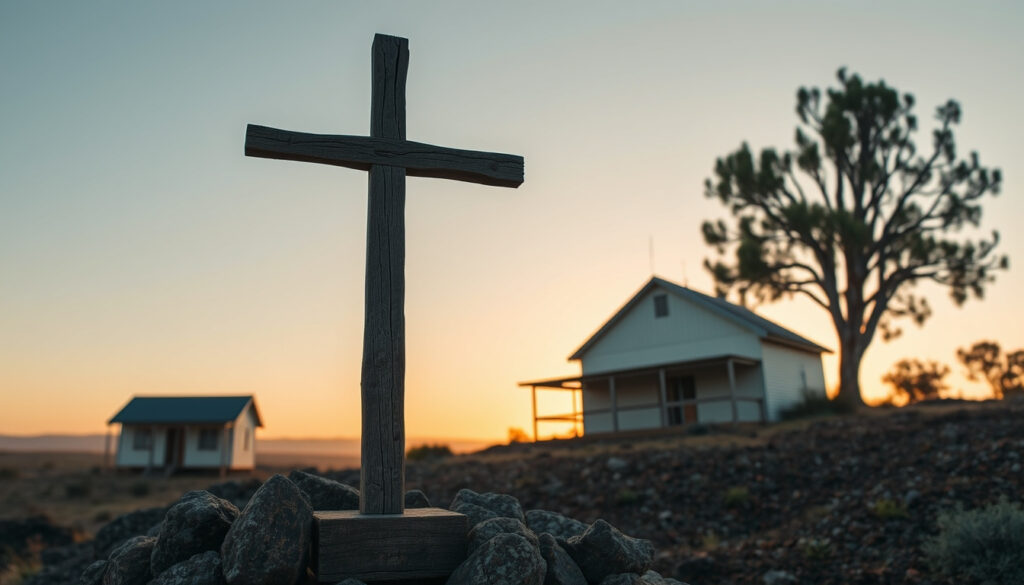
Saint Mary MacKillop: Biography, Miracles, and Legacy
There aren’t many people in history who have been both excommunicated by the Church and later declared a saint. Mary MacKillop, Australia’s first canonized saint, achieved that unlikely arc—born in Melbourne in 1842, she founded a religious order dedicated to educating the poor, only to be excommunicated in 1871 before being vindicated within a year, leading to canonization by Pope Benedict XVI in 2010.
Born: 15 January 1842 ·
Died: 8 August 1909 ·
Canonized: 17 October 2010 ·
Feast Day: 8 August ·
Founded: Sisters of Saint Joseph in 1866
Quick snapshot
- Born 15 January 1842 in Fitzroy, Melbourne (Australian Dictionary of Biography (primary biographical reference))
- Founded Sisters of St Joseph in 1866 (Mary MacKillop Place (official shrine and archive))
- Canonized 17 October 2010 (Sisters of Saint Joseph (religious congregation documentation))
- Excommunicated 1871, lifted 1872 (Encyclopaedia Britannica (established reference work))
- Exact number of schools founded during her lifetime (no definitive list)
- Precise wording of her famous quote — “Never see a need without doing something about it” — widely attributed but not perfectly verified
- Details of the second miracle (patient name and precise illness not publicly confirmed)
- 1842 – Born
- 1866 – Founded order
- 1871 – Excommunication
- 1872 – Lifted
- 1995 – Beatified
- 2010 – Canonized
- Continued educational mission of the Sisters of St Joseph across Australia and beyond
- Growing devotion; feast day on 8 August celebrated by parishes
- Her story remains a model of perseverance for those navigating institutional conflict
Seven key facts about MacKillop’s life paint a clear biographical picture:
| Full Name | Mary Helen MacKillop (religious name: Mary of the Cross) |
|---|---|
| Born | 15 January 1842, Fitzroy, Melbourne, Australia |
| Died | 8 August 1909, North Sydney, Australia |
| Feast Day | 8 August |
| Canonization | 17 October 2010, by Pope Benedict XVI |
| Religious Order | Sisters of Saint Joseph of the Sacred Heart (Josephites) |
| Patronage | Archdiocese of Brisbane, Australia |
What is Mary MacKillop famous for?
What is Mary MacKillop’s legacy?
Mary MacKillop is best known as Australia’s first canonized saint and the founder of the Sisters of Saint Joseph of the Sacred Heart. Together with Father Julian Tenison Woods, she established the order in 1866 with a mission to educate children in remote and underserved areas (Mary MacKillop Place (official shrine and archive)). The congregation opened its first school in Penola, South Australia, in 1867 and expanded into welfare work across the country.
MacKillop’s focus on rural education filled a gap left by the colonial government, giving poor and isolated children access to schooling that many would otherwise never have received.
By the time of her death in 1909, the Josephites were a fixture of Catholic education in Australia. The order continues to operate schools today, maintaining her vision for serving the poor (Sisters of Saint Joseph (religious congregation documentation)). Her feast day is 8 August, the anniversary of her death.
Why is she considered a saint?
The Catholic Church recognized MacKillop’s holiness through the formal canonization process, which required evidence of heroic virtue and two verified miracles. Pope Benedict XVI canonized her on 17 October 2010 at St. Peter’s Square (Mary MacKillop Place (official shrine and archive)). Her sainthood reflects both her personal faith and her life of service to the poor, which the Church views as exemplary.
The implication: MacKillop’s sainthood is not merely a biographical footnote—it functions as an institutional endorsement of her model of educational charity, despite the earlier conflict with church leadership.
What was Mary MacKillop’s miracle?
What miracles led to her canonization?
Two miracles were attributed to MacKillop’s intercession. The first, recognized for her beatification in 1995, involved the healing of Kathleen Evans, a Australian woman with leukemia, in 1961. The second miracle, which cleared the path for canonization, involved the healing of a woman with lung cancer in the 1990s (Sisters of Saint Joseph (religious congregation documentation)). Both healings were investigated and approved by the Vatican’s Congregation for the Causes of Saints.
While the Vatican accepted both recoveries as medically unexplained, independent medical reviews are confidential. The exact criteria for “inexplicable” healing remain debated, but the process satisfies the Church’s requirements for saintly intercession.
The pattern: MacKillop’s miracles are both cancer-related, a disease that remains a common focus of prayer for healing today.
What is Mary MacKillop’s famous saying?
What is the most famous quote of Mary MacKillop?
“Never see a need without doing something about it” is the phrase most often associated with MacKillop. It captures her practical, service-oriented spirituality and is frequently cited by the Josephite order. However, the exact wording is widely attributed rather than found in a definitive original source (Franciscan Media (Catholic devotional publication)).
Other notable sayings
Another attributed line is “We are but travellers here, not permanent residents,” which reflects her view of earthly life as temporary. Both quotes align with her letters and the spirit of her work, even if precise documentary proof is elusive.
The implication: These sayings have become rallying phrases for Catholic social justice movements in Australia, giving MacKillop a voice that extends beyond her lifetime.
What did Mary MacKillop do when she was 14?
What was Mary MacKillop’s childhood like?
Mary was the eldest of eight children born to Scottish immigrants Alexander MacKillop and Flora MacDonald (SA History Hub (South Australian government historical resource)). The family struggled financially, and Mary had to contribute from an early age.
What job did she take at 14?
At the age of 14, she began working as a clerk to support her family. This early exposure to the realities of poverty and the need for practical help shaped her later decision to found an educational order (Sisters of Saint Joseph (religious congregation documentation)). She later worked as a governess and teacher before entering religious life.
How did her early life shape her vocation?
Her father was a teacher and her mother was deeply religious. Combined with the financial hardships, these influences gave MacKillop both a passion for education and a concrete understanding of what children in need required. The catch: she could not afford formal teacher training, so she learned on the job—a pattern that defined her pragmatic approach.
Was Mary MacKillop Irish?
What was Mary MacKillop’s ethnicity?
Mary MacKillop’s parents were Scottish immigrants, not Irish. Alexander MacKillop and Flora MacDonald MacKillop both came from Scotland (SA History Hub (South Australian government historical resource)). Mary herself was born in Fitzroy, Melbourne.
Is she considered Australian or Irish?
She is universally regarded as Australian. The common misconception that she was Irish likely stems from the fact that many Australian Catholics of her era were of Irish descent, but MacKillop’s own lineage is Scottish. The implication: this frames her as a product of colonial Australia’s mix of British immigrants.
Why was Mary MacKillop kicked out of the church?
What led to Mary MacKillop’s excommunication?
In September 1871, Bishop Laurence Sheil of Adelaide excommunicated MacKillop. The official grounds were insubordination, but the deeper issue involved a conflict over governance. Sheil had been convinced by a priest that MacKillop was mismanaging funds and disobeying authority. In reality, the Josephite sisters were trying to maintain independent leadership—a challenge to the bishop’s control (Encyclopaedia Britannica (established reference work)).
How long was she excommunicated?
She was excommunicated for less than a year. After Sheil’s death in early 1872, an investigation cleared MacKillop and the excommunication was lifted in February 1872 (Encyclopaedia Britannica (established reference work)). Later accounts describe the controversy as stemming from friction over the sisters’ autonomy rather than a rejection of MacKillop’s piety (Franciscan Media (Catholic devotional publication)).
What was the controversy with Bishop Sheil?
Sheil had been swayed by complaints against MacKillop and made the excommunication decision without giving her a chance to defend herself. When the bishop died, the new administration quickly reversed the penalty. The episode left MacKillop with a reputation for resilience, but also a deep awareness of institutional vulnerability.
The pattern: the excommunication is often cited as a case of church hierarchy overreach, and MacKillop’s vindication became a key part of her hagiography.
Timeline of Mary MacKillop’s life
- 15 January 1842 – Born in Fitzroy, Melbourne (Australian Dictionary of Biography (primary biographical reference))
- 1856 – Began work as a clerk at age 14
- 1866 – Founded the Sisters of Saint Joseph with Father Julian Tenison Woods (Mary MacKillop Place (official shrine and archive))
- 1867 – Opened first Josephite school in Penola, South Australia
- September 1871 – Excommunicated by Bishop Laurence Sheil (Encyclopaedia Britannica (established reference work))
- February 1872 – Excommunication lifted after investigation (Encyclopaedia Britannica (established reference work))
- 8 August 1909 – Died in North Sydney (Sisters of Saint Joseph (religious congregation documentation))
- 1995 – Beatified by Pope John Paul II (Mary MacKillop Place (official shrine and archive))
- 17 October 2010 – Canonized by Pope Benedict XVI (Mary MacKillop Place (official shrine and archive))
The implication: this timeline shows the resilience of MacKillop’s mission despite early setbacks.
Clarity: what’s confirmed and what’s debated
Confirmed facts
- Birth and death dates as recorded in civil and church records (Australian Dictionary of Biography (primary biographical reference))
- Excommunication and lifting dates (1871–1872) (Encyclopaedia Britannica (established reference work))
- Canonization date (2010) (Mary MacKillop Place (official shrine and archive))
- Founding of Sisters of St Joseph in 1866 (Sisters of Saint Joseph (religious congregation documentation))
What remains unclear or debated
- Exact number of schools founded during her lifetime (no definitive list)
- Precise wording of her first quote – “Never see a need…” is widely attributed but not verified in a primary source
- Details of the second miracle (patient name and precise illness remain confidential)
- Some accounts soften the excommunication conflict, while others emphasize it as a major church injustice
“Never see a need without doing something about it.”
— Attributed to Mary MacKillop (Franciscan Media (Catholic devotional publication))
“We are but travellers here, not permanent residents.”
— Attributed to Mary MacKillop
“Australia’s first canonized saint, Mother Mary MacKillop founded the Sisters of Saint Joseph of the Sacred Heart. She is a model of courage and faith.”
— Franciscan Media (Franciscan Media (Catholic devotional publication))
For the Catholic faithful in Australia, MacKillop’s life offers a lesson in institutional tension and personal faith: the Church that once rejected her now venerates her—and that paradox continues to shape how believers understand holiness. The decision for those studying her path is clear: embrace the uncomfortable truth that saints are forged in conflict, not despite it.
en.wikipedia.org, insidethevatican.com, youtube.com, franciscanmedia.org, sosj.org.au, abc.net.au
Frequently asked questions
Where was Mary MacKillop born?
She was born in Fitzroy, Melbourne, Australia, on 15 January 1842.
When did Mary MacKillop die?
She died on 8 August 1909 in North Sydney, Australia.
How old was Mary MacKillop when she died?
She was 67 years old.
What is Mary MacKillop’s feast day?
Her feast day is 8 August, the anniversary of her death.
Who founded the Sisters of St Joseph?
Mary MacKillop co-founded the Sisters of Saint Joseph of the Sacred Heart with Father Julian Tenison Woods in 1866.
What is the mission of the Sisters of St Joseph today?
The congregation continues its focus on education and service to the poor, operating schools and welfare programs mainly in Australia and New Zealand.
The implication: These questions address common curiosities about MacKillop’s life and legacy.
Related reading
- Mrs Macquarie’s Chair – History, Location & Visitor Guide – An Australian heritage landmark with connections to colonial Australian history.
- Morning Star: Meaning, Symbolism, and History Across Cultures – Explores a symbol often associated with saintly devotion, offering a thematic link to Mary MacKillop’s spiritual legacy.
More related posts
 Charlie Curnow: Girlfriend, Salary, Net Worth, and Swans Trade
 Chris Bath 2026: Career, Husband, Net Worth & Latest News
 Sarina Russo: From Typing School to Employment Empire
 Peter Falk: Death, Eye, and Daughter Lawsuit
 Clayton Utz: History, Offices and Gender Equality
 Hubert Hurkacz: Knee injury, Wimbledon withdrawal, and career update
 Tom Hollander: Biography, Best Movies & TV Shows
 Gary Burghoff: M*A*S*H, His Hand, and Life Now