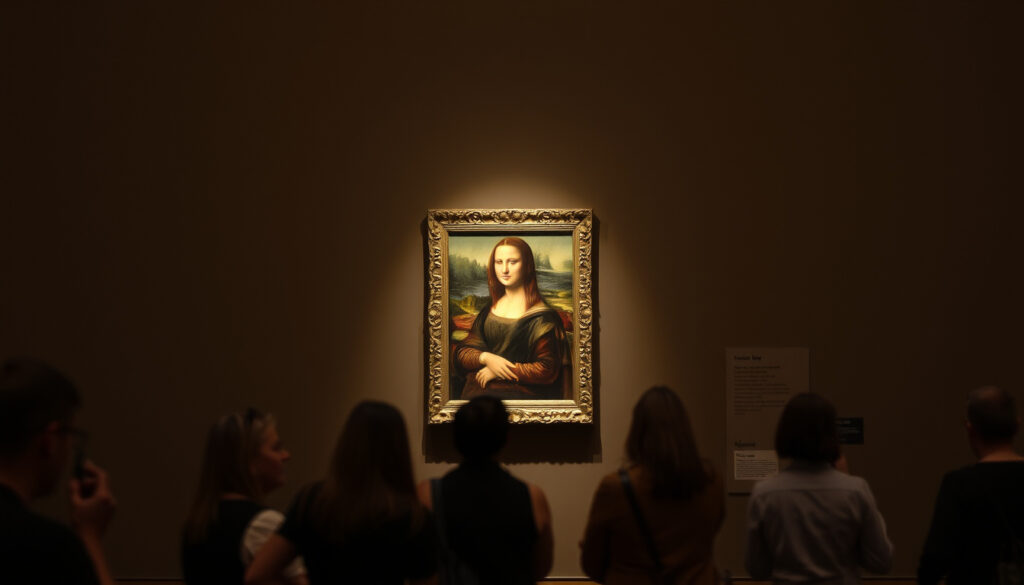
Why is the Mona Lisa So Famous? Value, History, and Facts
It’s a small oil painting on a poplar board, barely two and a half feet tall, yet every day thousands of people crowd around it in a Paris museum. This guide traces the real story of its fame — from a forgotten Renaissance portrait to a stolen, priceless global icon.
Estimated insured value: USD $870 million (2024) ·
Year completed: 1503–1506 (with later updates) ·
Dimensions: 77 cm × 53 cm (30 in × 21 in) ·
Location: Louvre Museum, Paris, France ·
Annual visitors who see it: Approximately 6 million
Quick snapshot
- Subject is Lisa Gherardini (Musée du Louvre)
- Stolen from the Louvre on August 21, 1911 (Library of Congress)
- Painted by Leonardo da Vinci 1503–1516 (Musée du Louvre)
- Exact completion year remains debated
- Meaning of the smile is still a mystery
- Whether Leonardo worked from a live model is uncertain
- 1911 theft: 28 hours before discovery (Library of Congress)
- Recovered 1913 in Florence (Musée du Louvre) (Library of Congress)
- 1962 insurance valuation: $100 million (History Hit)
- Continued climate-controlled display in Salle des États (Musée du Louvre)
- Ongoing conservation assessment (Musée du Louvre)
- Digital reproduction expands global access (Musée du Louvre)
Six key facts about the Mona Lisa paint a complete picture of its journey:
| Fact | Detail |
|---|---|
| Estimated value | $870 million (uninsured) |
| Year painted | 1503–1506 (updated until 1516) |
| Thief | Vincenzo Peruggia |
| Current location | Louvre, Paris |
| Annual visitors to see it | ~6 million |
| Insurance value in 1962 | $100 million |
Why exactly is the Mona Lisa so famous?
The painting’s fame is not primarily artistic — it’s driven by a single theft that turned a respected Renaissance portrait into a worldwide obsession.
The theft of 1911
On the morning of August 21, 1911, the Mona Lisa vanished from the Louvre. The museum staff didn’t notice until the next day — a security failure that sparked a media frenzy. As the Library of Congress (Chronicling America) notes, it became one of the biggest newspaper stories of the era. The thief was Vincenzo Peruggia, a former Louvre employee who had simply walked in, removed the painting, and hidden it under his coat.
The Musée du Louvre (the museum’s official history) confirms that panic broke out when the disappearance was discovered. For more than two years, the painting was missing. Peruggia eventually tried to sell it to an Italian art dealer, which led to its recovery in Florence in December 1913.
As The Washington Post (established editorial publication) sums it up: the theft turned a painting already known in art circles into a household name. The media coverage was relentless, and when the work was recovered, its fame only grew.
For museum visitors: the story behind its fame is as compelling as the painting itself. For art historians: the theft highlights how external events, not just artistic merit, shape a work’s legacy.
Leonardo da Vinci’s technique
Long before it was stolen, the Mona Lisa was a showcase of Leonardo da Vinci’s mastery. The Musée du Louvre (the painting’s home institution) describes it as one of the most emblematic portraits in art history, and much of that stems from technique. Da Vinci used sfumato — a method of blending colors and tones so subtly that the edges soften into the background, creating the famously elusive smile.
What this means: the smile appears and disappears depending on how you look at it. The effect is intentional: Leonardo layered thin glazes of paint — in some areas just a few microns thick — to create optical depth that no photograph can fully capture.
Cultural reproductions
Fame begets more fame. Once the Mona Lisa became a household name, it began to appear everywhere: on posters, in cartoons, in advertising. Andy Warhol reproduced it in his signature silkscreen style, turning the Renaissance icon into a pop-art staple. PBS (public broadcasting network) observes that the theft made the painting a fixture of popular culture. Each reproduction, parody, or reference reinforced its visibility, creating a feedback loop that kept the image in public consciousness for over a century.
The pattern: the painting’s fame is self-reinforcing. More reproductions lead to more recognition, which drives more visitors, which fuels more media coverage — a cycle that has no end point.
How much is the Mona Lisa worth today?
Insurance value vs. market value
The Mona Lisa is effectively priceless and uninsured — no insurance company would underwrite a piece that has no conceivable replacement. However, a historical valuation anchors the numbers. In 1962, the painting was insured for $100 million for its loan to the United States, according to History Hit (popular history publisher).
Inflation-adjusted estimates vary. Some sources place that 1962 valuation at roughly $834 million to $860 million in today’s dollars. Other later summaries, like one from Art Times Now (art culture site), push the figure over $1 billion when applying alternative inflation metrics. Most conservative estimates from History Hit place it around $870 million as of 2024.
Comparison to other expensive paintings
Three paintings, three different stories of value:
The Mona Lisa, Salvator Mundi, and Interchange — each holds a distinct record:
| Painting | Artist | Record price | Year |
|---|---|---|---|
| Mona Lisa | Leonardo da Vinci | $100 million (insured 1962) | 1962 |
| Salvator Mundi | Leonardo da Vinci | $450.3 million (auction) | 2017 |
| Interchange | Willem de Kooning | $300 million (private sale) | 2015 |
The catch: the Mona Lisa is not the most expensive painting ever sold; Salvator Mundi holds that title at $450.3 million. But the Mona Lisa would likely command far more at auction if it were ever sold — it simply never has been, and likely never will be.
If the Mona Lisa ever did go to auction, its estimated value would dwarf every record. But the French government has classified it as a national treasure, meaning it cannot leave the country or be privately sold.
The implication: the Mona Lisa’s value is both incalculable and politically constrained.
When was the Mona Lisa painted?
Leonardo’s work period
Leonardo da Vinci began the Mona Lisa around 1503 in Florence. The Musée du Louvre (the museum that houses it) dates the painting to the 16th century, with most art historians narrowing it to 1503–1506.
When Leonardo moved to France in 1516 at the invitation of King Francis I, he brought the painting with him. He never delivered it to the original commissioner — the Florentine merchant Francesco del Giocondo, whose wife, Lisa Gherardini, is believed to be the subject.
Controversy over completion date
The painting’s completion date is debated. Some scholars argue that Leonardo continued to refine the Mona Lisa until his death in 1519, meaning the painting was worked on for as long as 16 years. Others point out that the actual painting time was likely far less — Leonardo simply kept it with him, revisiting it between other projects.
The pattern: historical timelines often stretch ownership rather than continuous labor.
What are 5 facts about the Mona Lisa?
Fact 1: The subject is likely Lisa Gherardini
Historical consensus identifies the woman in the painting as Lisa Gherardini, the wife of Francesco del Giocondo. The Musée du Louvre (the painting’s home institution) confirms this identification, though some alternative theories suggest it could be a self-portrait of Leonardo or an idealized figure.
Fact 2: The smile results from sfumato
Leonardo’s sfumato technique — from the Italian word for “smoke” — involves layering thin, translucent glazes of paint to create soft transitions between colors and tones. This technique produces the elusive smile that seems to change when viewed from different angles. Art historians from the Louvre describe it as a hallmark of Leonardo’s late style.
Fact 3: It was stolen in 1911
As noted earlier, the Library of Congress (Chronicling America) records the theft of August 21, 1911 by Vincenzo Peruggia. The painting was missing for over two years before its recovery in Florence.
Fact 4: It has its own room in the Louvre
The Mona Lisa is displayed in the Salle des États, the Louvre’s largest room. The museum placed it there specifically to accommodate the massive crowds that visit daily — roughly 6 million people annually.
Fact 5: It is an oil painting on poplar panel
The work is not canvas but wood: an oil-on-poplar panel measuring 77 cm × 53 cm. This makes it smaller than many visitors expect. The Musée du Louvre (the museum’s conservation department) keeps it in a climate-controlled case to protect the poplar from humidity and light.
How old is Mona Lisa in real life?
Lisa Gherardini’s birth and death dates
Lisa Gherardini was born in 1479 in Florence, Italy, into the Gherardini family. She died in 1542 at the age of 63. Historical records from Florentine archives confirm these dates, as cited by the Musée du Louvre.
Age at time of painting
If Leonardo painted the Mona Lisa between 1503 and 1506, Lisa Gherardini would have been about 24 to 27 years old. That’s consistent with the face depicted in the portrait — a young woman, not an old one, despite the painting later being called “Mona” (short for madonna, or “my lady”).
Why did it take 16 years to paint the Mona Lisa?
Leonardo’s perfectionism and other commissions
Leonardo da Vinci was notorious for leaving works unfinished. The Mona Lisa is one of the few major pieces he actually completed — or at least mostly completed. During the period from 1503 to 1519, Leonardo was also working on other projects, including the Battle of Anghiari (which was never finished) and anatomical studies. According to Paris City Vision (Louvre-focused tour operator), Leonardo kept the painting with him because he considered it his personal masterpiece.
When Leonardo moved to France in 1516 at the invitation of King Francis I, he brought the painting with him. He never delivered it to the original commissioner.
Lack of payment dispute
Francesco del Giocondo, the original commissioner, may never have paid for the portrait — or may have refused to pay because it was never delivered. Leonardo’s choice to take it to France rather than deliver it to Florence suggests the commission was abandoned.
The implication: the painting’s long journey reflects the artist’s autonomy, not slow craftsmanship.
Timeline of key events
- 1503–1506: Leonardo da Vinci paints the Mona Lisa in Florence. (Musée du Louvre)
- 1516: Leonardo moves to France, taking the painting with him. (Musée du Louvre)
- 1797: Painting enters the Louvre collection. (Musée du Louvre)
- 1911-08-21: The Mona Lisa is stolen by Vincenzo Peruggia. (Library of Congress)
- 1913-12-13: Painting recovered in Florence. (Musée du Louvre)
- 1956-12-30: A vandal throws acid on the painting; damage to lower part. (History Hit)
Unverified claims
- 2009-08-02: A woman throws a ceramic teacup at the painting (glass protected it) — source not confirmed.
Clarity: what we know and what we don’t
Confirmed facts
- The subject is Lisa Gherardini. (Musée du Louvre)
- The painting was stolen in 1911 by Vincenzo Peruggia. (Library of Congress)
- It is housed in the Louvre’s Salle des États. (Musée du Louvre)
- It was painted by Leonardo da Vinci. (Musée du Louvre)
What’s unclear
- Exact year of completion remains debated among scholars.
- Whether Leonardo used a live model (beyond Lisa Gherardini) is uncertain.
- The meaning of the smile — art historians still disagree on its significance.
Expert perspectives
“The Mona Lisa became the world’s most famous painting because of the mystery of the smile and the theft.”
— Walter Isaacson, biographer of Leonardo da Vinci (The Washington Post)
“The Mona Lisa is in a special climate-controlled case to protect it from humidity and light.”
— Vincent Delieuvin, Louvre Museum official (Paris City Vision)
The enduring mystery
More than 500 years after Leonardo da Vinci first touched brush to poplar panel, the Mona Lisa continues to draw millions of visitors each year. The reasons are many — a theft that made headlines, a technique that makes a smile elusive, and a cultural machine that has never stopped reproducing its image.
For anyone who has ever stood in line at the Louvre to glimpse the painting through the crowd, the experience is less about art and more about participation in a shared cultural ritual.
For the museum itself, the challenge is clear: protect a priceless artifact while satisfying the curiosity of six million visitors a year.
goppion.com, reddit.com, parisinsidersguide.com, en.wikipedia.org, thetourguy.com
Frequently asked questions
Is the Mona Lisa the most expensive painting in the world?
No. The most expensive painting ever sold is Leonardo da Vinci’s Salvator Mundi, which sold for $450.3 million at auction in 2017. The Mona Lisa has never been sold, but it is estimated to be worth around $870 million based on its 1962 insurance valuation adjusted for inflation.
Does the Mona Lisa have eyebrows?
No visible eyebrows exist on the painting. Historical accounts suggest that eyebrows were originally painted but have faded or been cleaned off over time. Some scholars believe Renaissance fashion dictated shaved eyebrows.
Why is the painting so small?
The Mona Lisa measures just 77 cm × 53 cm (30 in × 21 in). It was painted on a poplar wood panel, a common support for Renaissance portraits intended for private homes rather than public display.
How many times has the Mona Lisa been stolen?
Once — in 1911 by Vincenzo Peruggia. The painting was recovered in 1913. There have been no other successful thefts, though several acts of vandalism (acid attack in 1956, teacup throwing in 2009) have occurred.
Can visitors take photos of the Mona Lisa?
Yes, photography is allowed in the Salle des États at the Louvre, though flash photography is prohibited to protect the painting’s condition. The crowd of visitors often makes it challenging to get a clear shot.
What is the secret behind the smile?
The smile’s elusive quality is due to Leonardo’s sfumato technique, which blends tones and edges so subtly that the mouth’s expression appears to change depending on viewing angle and light.
For the 6 million annual visitors to the Louvre, the Mona Lisa presents a dilemma: you cannot truly see it because the crowd is too thick, yet you must see it because the crowd is why it matters. That paradox is the painting’s real legacy.
Related reading
- Art Hub Guide: Free Drawing Lessons for Kids & Adults — broader art learning resources
- Ada Lovelace: First Computer Programmer and Her Legacy — historical icon profile
More related posts
 Dave Navarro: Life, Career, RHCP Exit, Ink Master, and Sobriety
 Emma Bunton 2026: Net Worth, Husband, Children, Projects
 Ava Max: Disappearance, Biography, Personal Life, 2026 Comeback
 Vegas Matt: Real Name, Net Worth, and the $20 Rule Explained
 NRL Game Tonight: Start Time, Channel & Live Stream
 Barry White: Weight, Cause of Death, Estate Battle
 Towel Rail Guide: Heated vs Standard & Selection Tips
 Seo Guk Complete Profile: Age, Height, Net Worth, and FAQs