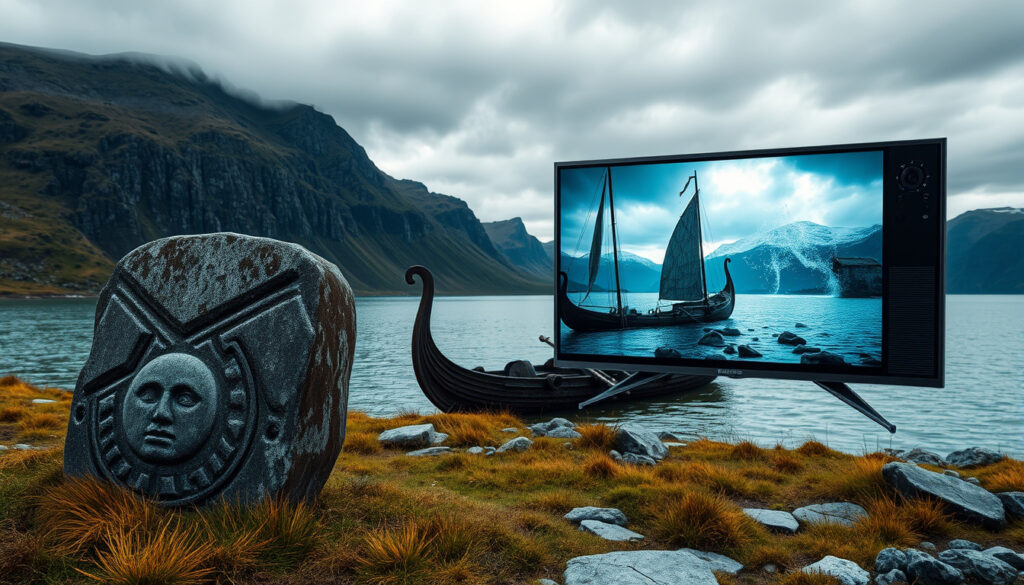
Ragnar Lothbrok: Real Viking Legend or TV Character
Few Viking names carry as much weight as Ragnar Lothbrok. The fire-lit hero of the History Channel’s Vikings is not quite the same figure who appears in medieval manuscripts. This article separates the historical threads from the television drama, using the oldest surviving sources. By the end, you’ll know what scholars actually know — and what remains legend.
Also known as: Ragnar Lodbrok ·
Era: 9th century ·
Legendary status: Semi-historical ·
TV portrayal: Travis Fimmel (2013–2016) ·
Wives in legend: 2 (Lagertha, Aslaug) ·
Sons in legend: At least 4 (Bjorn, Ivar, Ubbe, Sigurd)
Quick snapshot
- Ragnar is a legendary figure mentioned in medieval Norse sagas and European chronicles (Encyclopaedia Britannica)
- He is associated with 9th-century raids on England and France (Historic UK)
- The main literary source is the 13th-century Saga of Ragnar Lothbrok (History Hit)
- Whether Ragnar was a single historical person or a composite of multiple warriors (Encyclopaedia Britannica)
- The exact details of his life, wives, and death remain uncertain (History Hit)
- No contemporary records from the 9th century directly confirm his existence (Historic UK)
- c. 845 AD — Legendary siege of Paris led by Ragnar (Wikipedia)
- 9th century — The sagas record Ragnar’s deeds (Wikipedia)
- 865 AD — Traditional date of Ragnar’s death in Northumbria (Wikipedia)
- 2013 — Vikings TV series premieres with Ragnar as protagonist (IMDb)
- 2016 — Ragnar dies in Season 4 of Vikings (Wikipedia)
- Ragnar’s sons — Bjorn Ironside, Ivar the Boneless, Ubbe, Sigurd — continue Viking raids across Europe (Encyclopaedia Britannica)
- Legendary bloodline claimed by medieval dynasties such as the House of Munsö (Encyclopaedia Britannica)
- Modern TV series fuels renewed interest in the Ragnar myth (Encyclopaedia Britannica)
Seven key details about Ragnar Lothbrok, drawn from the most authoritative sources available, show why the line between history and legend is so thin.
| Label | Value |
|---|---|
| Full name | Ragnar Lodbrok (or Lothbrok) |
| Lived | c. 9th century |
| Known for | Raids on England and France, legendary deeds |
| TV actor | Travis Fimmel |
| First wife | Lagertha (legendary) |
| Second wife | Aslaug (legendary) |
| Notable sons | Bjorn Ironside, Ivar the Boneless, Ubbe, Sigurd |
Was Ragnar Lothbrok a real Viking?
What is the historical evidence for Ragnar Lothbrok?
- He appears in the 13th-century Saga of Ragnar Lothbrok and other Norse poems (History Hit (historical media outlet)).
- The Anglo-Saxon Chronicle mentions a Viking leader named “Reginherus” who besieged Paris in 845 — some historians link him to Ragnar (HISTORY (Facebook post)).
- No contemporary 9th-century inscription or official record names Ragnar directly (Encyclopaedia Britannica (academic reference work)).
How did the legend of Ragnar develop?
- Medieval Scandinavian skalds turned a possibly real raider into a larger-than-life hero (Historic UK (British historical organization)).
- The snake-pit death story — Ragnar killed by King Aella of Northumbria — is a legendary motif, not a documented event (Encyclopaedia Britannica).
- By the 12th century, chroniclers were writing about Ragnar and his sons as historical figures (HISTORY (Facebook post)).
Why was Ragnar removed from Vikings?
What happened in Season 4 of Vikings?
- Ragnar’s death in Season 4 was a planned narrative arc: he staged his own execution to incite revenge (IMDb (film and TV database)).
- Actor Travis Fimmel chose to leave the show after four seasons, and the writers decided to kill off the character (History Hit).
- The scene where Ragnar is thrown into a pit of snakes mirrors the legendary account from the sagas.
Did Ragnar plan his own death?
- In the show, Ragnar surrenders to King Aella and orchestrates his capture, knowing it will lead to his death and trigger a final Viking invasion (IMDb).
- This plot point is a TV invention — the sagas do not describe a staged death.
How many wives did Ragnar have?
Who were Ragnar’s wives?
- According to the Saga of Ragnar Lothbrok, Ragnar’s first wife was Lagertha, a famed shieldmaiden (History Hit).
- His second wife was Aslaug, a princess said to be the daughter of the legendary Sigurd and Brynhild (Encyclopaedia Britannica).
- Some versions of the saga mention a third wife, Thóra Borgarhjǫrtr, but most traditions settle on two.
Who was Lagertha?
- Lagertha is described in Saxo Grammaticus’s Gesta Danorum (12th century) as a skilled warrior who fought alongside Ragnar (Encyclopaedia Britannica).
- Her historicity is debated; she may be a literary character invented to glorify Ragnar’s lineage.
Who was Aslaug?
- Aslaug appears in the sagas as a prophetess who warned Ragnar that his sons would be born with deformities if he didn’t wait three days to consummate their marriage (History Hit).
- Ivar the Boneless is said to have been born with brittle bones as a result of Ragnar’s impatience.
Does the bloodline of Ragnar Lothbrok exist?
Are there modern descendants of Ragnar?
- Several medieval European royal families, notably the Swedish House of Munsö, claimed descent from Ragnar and his sons (Historic UK).
- No genealogical records from the 9th century exist to verify these claims.
- Modern DNA testing has not identified any direct line back to Ragnar because no confirmed biological remains are linked to him.
What does DNA evidence show?
- Genetic studies of modern Scandinavian populations can trace broad Viking‑era ancestry, but they cannot pinpoint a single legendary individual (Wikipedia (user-edited encyclopedia)).
- The idea of a continuous, provable bloodline from Ragnar remains in the realm of legend.
Is Bjorn actually Ragnar’s son?
Who was Bjorn Ironside?
- Bjorn Ironside is listed as a son of Ragnar in the Saga of Ragnar Lothbrok and other medieval sources (Encyclopaedia Britannica).
- He is reported to have led Viking raids into the Mediterranean, including an attack on Rome (actually on Luni, mistaken for Rome).
- Historical Bjorn Ironside likely lived in the 9th century and is often identified with a leader named “Björn” in Frankish annals.
Was Bjorn a real historical figure?
- Most historians accept Bjorn Ironside as a historical person, even if his exact parentage is uncertain (History Hit).
- In the TV series, Bjorn is the son of Ragnar and Lagertha; in the sagas he is the son of Ragnar and Aslaug. The shift was a creative choice.
Who was the most feared Viking ever?
How does Ragnar compare to other Vikings?
- Ragnar’s reputation in the sagas is that of a great king and raider, but he is not usually ranked as the most feared (History Hit).
- Ivar the Boneless, Ragnar’s son, is described in the Ragnarssona þáttr as a ruthless leader who used terror tactics (Encyclopaedia Britannica).
- Harald Hardrada (11th century) is often called the “last great Viking” and was a feared warrior who fought from Scandinavia to Byzantium (Wikipedia).
- Modern pop culture often elevates Ragnar because of the TV series, but medieval sources give that title more often to Ivar or Harald.
Timeline
Five dates that mark the boundary between Ragnar’s probable history and the legend that grew around him.
| Date | Event |
|---|---|
| 793 AD | First recorded Viking raid on Lindisfarne (context for Ragnar’s era) (Historic UK) |
| c. 845 AD | Legendary siege of Paris led by a Viking named Reginherus, possibly Ragnar (Encyclopaedia Britannica) |
| 9th century | Ragnar’s life and exploits recorded in Icelandic sagas (History Hit) |
| 2013 | Vikings TV series premieres with Ragnar as protagonist (IMDb) |
| 2016 | Ragnar dies in Season 4 of Vikings |
The timeline shows that the historical figure (if he existed) lived roughly 200 years before the sagas were written down. That gap allowed ample room for embellishment. Every date before 2013 is reconstructed from later literature.
What we know and what remains unclear
Confirmed facts
- Ragnar is a legendary figure mentioned in medieval Norse sagas and European chronicles (Encyclopaedia Britannica).
- He is associated with 9th‑century raids (Historic UK).
- The snake‑pit death story is a legendary motif, not history (Encyclopaedia Britannica).
What’s unclear
- Whether Ragnar was one person or a composite of several raiders (History Hit).
- The exact details of his life, wives, and death (Encyclopaedia Britannica).
- Whether the bloodline survived in any verifiable form (Wikipedia).
Expert perspectives
Ragnar Lothbrok (flourished 9th century) was a Viking whose life passed into legend.
— Encyclopaedia Britannica (academic reference work)
Arguably the most famous Viking warrior was the semi‑legendary sea king, Ragnar Lothbrok.
— History Hit (historical media outlet)
Ragnar Lodbrok or Ragnar Lothbrok, according to legends, was a Viking hero and a Swedish and Danish king.
— Wikipedia (user-edited encyclopedia)
Ragnar is simultaneously the most famous Viking and one of the least historically verifiable. His fame today owes far more to a television script than to the medieval parchment that first recorded his name.
For anyone trying to understand the real Ragnar Lothbrok, the lesson is clear: the man is inseparable from the legend. The sagas offer a compelling story, but they were written centuries after the events they describe. Modern audiences who want a definitive answer about his life will be disappointed — that’s the nature of semi‑legendary figures. For the curious reader, the richest takeaway is not the facts (which are scarce) but the process by which a ninth‑century raider became a symbol of Viking identity.
bjornlarssen.com, historymedieval.com, youtube.com, reddit.com, youtube.com, vikings.fandom.com
For a deeper look at the evidence behind the sagas, see this analysis of Ragnar Lothbroks historical reality.
Frequently asked questions
Did Ragnar really marry a shieldmaiden?
In the sagas, his first wife Lagertha is described as a shieldmaiden. However, no contemporary source confirms her existence outside Saxo Grammaticus’s 12th‑century history (History Hit).
What was Ragnar’s real name?
Both “Ragnar Lodbrok” and “Ragnar Lothbrok” appear in medieval texts. “Lodbrok” likely means “Leather Breeches,” a nickname from the saga (Encyclopaedia Britannica).
How did Ragnar die in real life?
The most famous account — death in a snake pit — is a legendary motif. No historical record describes his death with certainty. It may have occurred during a raid in Northumbria around 865 AD (Encyclopaedia Britannica).
Was Ivar the Boneless truly Ragnar’s son?
Yes, in all surviving saga versions. Ivar is consistently named as one of Ragnar’s sons, along with Bjorn, Ubbe, and Sigurd (History Hit).
What does “Lothbrok” mean?
It is generally interpreted as “hairy breeches” or “leather breeches,” a reference to the shaggy fur trousers Ragnar supposedly wore to protect himself from a serpent (Encyclopaedia Britannica).
Are there any artifacts linked to Ragnar?
No. No physical object (weapon, coin, runestone) can be directly tied to Ragnar. All evidence is literary (Historic UK).
Was Ragnar a king?
According to the sagas, he was a Danish and Swedish king. Some medieval chronicles refer to him as a “sea king” — a leader of Viking fleets rather than a territorial ruler (Wikipedia).
Did Ragnar have a famous sword?
In Norse tradition, swords often had names and backstories, but no specific weapon is consistently attributed to Ragnar across the sources (History Hit).
More related posts
 Protest Melbourne Today: Live Updates, Times and Locations
 Harold Shipman: Serial Killer Doctor and the Shipman Inquiry
 Parasympathetic Nervous System: Function, Activation, and Healing
 Danika Mason: Partner, Career, and Engagement Updates
 Suni Lee: Biography, Health, Net Worth, and Ethnicity
 Jesse Jackson: Civil Rights Icon, PSP Diagnosis, and Legacy
 Go Card Login QLD: Official TransLink Guide and Steps
 Peter Phelps: Baywatch Actor, Wife Donna, and Current Life