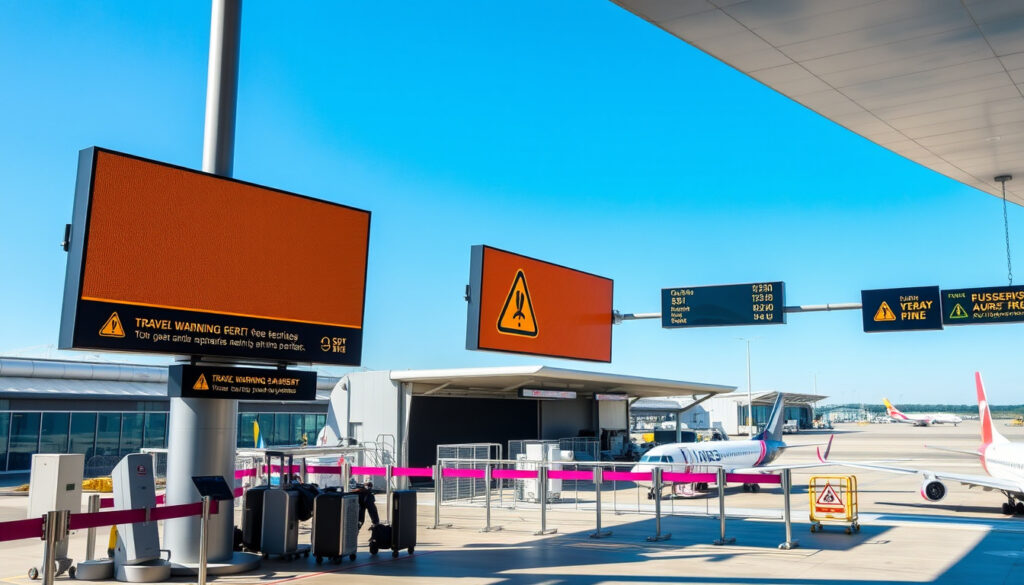
Aussie Airport Travel Warning: What You Need to Know Now
Sydney’s strict 11pm–6am curfew is clashing with the longest sustained aviation disruption of 2026 — and that collision is reshaping how airlines route through Australia. The April 2026 crisis has pushed Sydney Airport to 164 delays and 3 cancellations in a single day while simultaneously adding another hard constraint on top of weather-related knock-on effects.
Aircraft in Airbus upgrade warning: 6,000 A320s ·
Sydney Airport curfew time: 11pm ·
Smartraveller Do Not Travel example: Somalia ·
Smartraveller High Caution example: Liberia
Quick snapshot
- Sydney Airport curfew runs 11pm–6am under the Sydney Airport Curfew Act 1995 (Australian Government Dept of Infrastructure)
- Body corporate curfew breaches can result in fines over $1.1 million (Australian Government Dept of Infrastructure)
- Exact scale of passenger impacts at major airports not independently confirmed beyond secondary reporting (Travel Tourister)
- Whether April 2026 disruption figures represent ongoing conditions or are beginning to ease (Travel Tourister)
- AU/NZ aviation entered Day 22 of disruption on April 22, 2026 — the longest sustained sequence of 2026 (Travel Tourister)
- Brisbane Airport Rail Link expected to resume April 26, 2026 (Travel Tourister)
- Air New Zealand has cut 4% of May and 5% of June 2026 capacity due to ongoing disruption cascade (Travel Tourister)
- Western Sydney International Airport (WSI) operates 24/7 with no movement caps, offering an uncapped alternative to SYD (Travel Weekly Asia)
Is it safe to travel to Australia right now?
Current airport disruptions
The AU/NZ aviation network is in uncharted territory. On April 22, 2026, Australia and New Zealand’s aviation networks entered Day 22 of the April 2026 crisis — the longest sustained disruption sequence of the year so far. According to Travel Tourister, the region recorded 418 total disruptions that day: 394 delays and 24 cancellations spread across multiple airports. Sydney Airport saw 164 delays and 3 cancellations on April 21 alone, the highest count in the network for that date.
The cascade started with Auckland fog on April 22, which reduced runway capacity to 40–60%. Fog-related disruptions at Auckland then rippled across the Tasman, affecting connections through Sydney. Air New Zealand was the worst-hit carrier, according to Travel Tourister, due to the combined effect of fog and a lightning strike cascade from a Singapore service. Meanwhile, the Brisbane Airport Rail Link has been shut since Day 20 of the disruption period, with service not expected to resume until April 26, 2026 — adding a ground-transport layer to the flying chaos.
For domestic and trans-Tasman travelers, Qantas is currently recommending passengers allow 3 hours for international check-in at Sydney Terminal 1 during the disruption window, according to Travel Tourister. That’s notably longer than the usual check-in window.
Smartraveller advisories
Smartraveller, Australia’s official government travel advisory service, advises Australian citizens to check itineraries for any “Do not travel” transit locations because airports in certain regions have been targeted. The advisory, published on Smartraveller, is blunt: “Even transiting a ‘Do not travel’ travel hub puts your safety at risk. Airports have been targeted and you may be unable to leave.”
For New Zealand travel specifically, Smartraveller advises exercising normal safety precautions — a lower threshold than advisories for other regions. The US destination page notes that travelers to America may experience flight delays and longer lines at entry points, according to Smartraveller’s US travel guidance.
For travelers flying through or within Australia right now, the disruption isn’t just weather-related — it’s a cascading system problem. Air New Zealand has already cut capacity by 4% in May and 5% in June 2026 in response. If your journey depends on trans-Tasman connections, build in extra buffer time and monitor your airline’s real-time updates.
What countries are under a travel alert?
Smartraveller levels
Smartraveller uses a four-level advisory system, ranging from Level 1 (Exercise normal safety precautions) through Level 4 (Do not travel). The system applies to every country and territory globally, with Level 4 reserved for destinations where the security situation poses an immediate risk to travelers. The Middle East conflict is currently generating global flight cancellations and disruptions, according to Smartraveller’s current advisory coverage.
Hong Kong falls into a specific sub-category: Smartraveller advises a high degree of caution due to national security laws that have applicability overseas. That means Australian citizens could be subject to laws not applicable in their home country simply by being present in Hong Kong.
Do not travel destinations
Somalia is currently on the Smartraveller Level 4 “Do not travel” list. The advisory warns that even transiting through a Somali airport puts travelers at serious risk — airports in the region have been specifically targeted. Liberia represents a Level 2 “High degree of caution” destination, sitting in the middle range of the advisory spectrum.
The distinction matters for travelers: “Do not travel” advisories aren’t just strong suggestions. They reflect situations where Australian consular assistance may be severely limited or unavailable. Smartraveller explicitly notes that transit through high-risk hubs can trap travelers — you may find yourself unable to leave an airport or country if conditions deteriorate.
Airlines and travel insurance typically treat Level 4 advisories as triggers for refund rights or rebooking flexibility. If your itinerary passes through a “Do not travel” country, contact your airline before you fly — and check your policy wording on routing through high-risk zones.
Why does Sydney airport have an 11pm curfew?
Curfew details
Sydney Kingsford Smith Airport operates under one of the strictest airport curfews in Australia, enforced between 11:00 pm and 6:00 am local time. The curfew is governed by the Sydney Airport Curfew Act 1995, along with associated Regulations, a Dispensation Guideline from 2016, and the Curfew Aircraft Instrument 2015, according to the Australian Government Department of Infrastructure.
The curfew isn’t absolute. Aircraft that can operate during the restricted hours include propeller-driven planes up to 34,000 kilograms maximum takeoff weight, specific approved jet aircraft types, emergency flights, and those with formal dispensations. During the “shoulder” periods — 11pm to midnight and 5am to 6am — the rules relax slightly: a maximum of 24 international passenger landings per week is permitted during shoulders, with a daily cap of 5, but zero take-offs are allowed between 11pm and midnight, according to the Department of Infrastructure.
A critical rule for airlines: an aircraft must not depart its origin if its estimated time of arrival at Sydney falls at 11:00 pm or later, unless the operator has secured a dispensation in advance. On weekends, curfew-affected aircraft must operate over Botany Bay for one hour before and after the restricted period if it is safe to do so.
Australia has matching 11pm–6am curfews at Adelaide, Essendon, Gold Coast, and Sydney airports, enforced by Airservices Australia, which has powers to prosecute operators for breaches. A curfew violation by a body corporate can result in fines exceeding $1.1 million, according to the Department of Infrastructure.
Impact on travel
The curfew creates a hard deadline for late-evening flights into Sydney. If you’re on a long-haul from Asia or the Americas that might run late, your airline needs to either adjust the schedule or secure a dispensation. During the current disruption period, the curfew adds another constraint on top of weather delays — a delayed flight that misses its 11pm window may be forced to divert or wait until the morning shoulder.
By contrast, Western Sydney International Airport (WSI) has no curfew and no movement caps whatsoever. Travel Weekly Asia reports that Singapore Airlines is already adding a fifth daily flight to Western Sydney specifically because of the operational freedom the 24/7 facility offers. WSI is positioned as a direct alternative for airlines and travelers who need guaranteed late-night or early-morning access.
What are the latest Aussie airport travel warnings?
Airbus maintenance alerts
Airbus has issued a maintenance alert affecting approximately 6,000 operational A320-family aircraft globally. While the alert doesn’t specifically reference Australian operations, the scale of the affected fleet means potential disruptions for any airline operating A320 variants on Australian routes. This type of fleet-wide maintenance directive typically requires airlines to ground aircraft for inspection and repair within specified windows, which can trigger schedule changes.
The alert adds to existing capacity pressures in the AU/NZ aviation network. Air New Zealand has already responded by cutting 4% of May and 5% of June 2026 capacity, according to Travel Tourister. The Australian Competition and Consumer Commission (ACCC) is also enhancing its airline monitoring during this period, suggesting regulators are watching for consumer-harm patterns in how airlines handle cancellations and rebookings.
Fuel disruption risks
Middle East tensions are creating fuel-supply uncertainty that extends beyond the region itself. Global aviation fuel markets are interconnected — disruptions in the Gulf can push up prices and create supply squeezes that affect airlines operating routes nowhere near the conflict zone. Smartraveller’s current advisory notes that the Middle East conflict is causing flight cancellations and disruptions globally, making fuel risk a factor even for purely domestic Australian itineraries if airlines adjust schedules to manage fuel costs.
The combination of fog cascades from Auckland, the Airbus maintenance alert, and fuel supply uncertainty creates a layered risk picture. No single factor is responsible — it’s the interaction between policy constraints like the Sydney curfew, operational pressures from weather and maintenance, and market-level fuel risks that’s making April 2026 particularly challenging for AU/NZ aviation.
The ACCC’s enhanced airline monitoring means disruption-related consumer complaints will be under heightened scrutiny in the coming weeks. If your flight is cancelled or significantly delayed, Australian Consumer Law entitles you to certain protections — know your rights before you accept a voucher or rebooking offer that may not be in your favor.
What do DFAT and Smartraveller advise?
Travel warnings for Australian citizens
The Department of Foreign Affairs and Trade (DFAT) operates Smartraveller as its official channel for travel advisories. The platform provides country-by-country guidance across four risk levels and issues specific alerts for regions experiencing acute instability. For Australian citizens traveling abroad, Smartraveller is the primary reference — it reflects DFAT’s current assessment of conditions on the ground.
The current Middle East advisory is significant. Smartraveller warns that airports in conflict-affected regions have been targeted, which means even transit through a “Do not travel” country — not necessarily your final destination — can put you in danger. The advisory language is unambiguous: if your connection route passes through a Level 4 destination, you should change your itinerary.
Qantas updates
Qantas, as Australia’s largest airline, provides its own disruption communications through its website and app. During the April 2026 crisis, Qantas has been recommending that passengers allow 3 hours for international check-in at Sydney Terminal 1 — an unusually long window that reflects both the volume of disrupted passengers and the cascading effects of connections from delayed arriving flights.
The airline’s social and digital channels have been publishing real-time updates on affected routes, but the volume of disruption means delays on one flight can propagate through connection banks. Passengers with same-day international connections through Sydney should confirm their onward flight status before departing their origin airport.
“Even transiting a ‘Do not travel’ travel hub puts your safety at risk. Airports have been targeted and you may be unable to leave.”
— Smartraveller (Australian Government Travel Advisory)
“A breach of the curfew by a body corporate could result in fines of over $1.1 million.”
— Department of Infrastructure (Australian Government)
“Australia and New Zealand’s aviation networks enter Day 22 of the April 2026 crisis with 418 total disruptions.”
— Travel Tourister (Aviation News Publisher)
For travelers flying through or within Australia right now, the disruption isn’t just weather-related — it’s a cascading system problem. The implication is that capacity reductions and schedule changes will likely persist into May and June, with displaced passengers competing for fewer seats.
The contrast between Sydney’s strict curfew window and Western Sydney’s 24/7 operation illustrates how policy constraints intersect with operational realities. Airlines facing weather delays or maintenance pullouts now have at least one uncapped alternative, but Western Sydney’s route network is still building out.
Smartraveller’s transit warnings add a layer of geopolitical risk that sits separately from operational disruptions. The pattern emerging is that Middle East conflicts affect fuel markets and flight routes even for purely domestic Australian travelers, while Level 4 advisories create legal and consular exposure that most travelers haven’t factored into their planning.
Related reading: Severe Storms and Cyclone Alerts · Morgan Wallen Australia Tour 2026
Amid Airbus disruptions and Sydney curfew alerts, the Cairns Airport parking guide offers vital options for regional Aussie flights.
Frequently asked questions
Are Australian flights safe amid current warnings?
Australian domestic flights and flights within the AU/NZ region are generally operating under safety regulations. The disruption is operational — delays and cancellations from weather and cascading effects — rather than a safety incident. Smartraveller does not currently advise against travel to Australia itself. However, if your itinerary routes through the Middle East or other Level 4 destinations, those connections carry genuine risk.
What is the Smart Traveller do not travel list?
Smartraveller’s Level 4 “Do not travel” list covers countries and territories where the security situation poses immediate risk to travelers and where Australian consular assistance is severely limited. Somalia is currently on this list. The advisory applies to transit — if your flight route passes through a Level 4 airport, Smartraveller advises changing your itinerary.
Can I check Aussie airport travel warning map?
Smartraveller provides country-by-country advisories on its website rather than a single map. Each destination page includes the current risk level, specific alerts for acute situations, and practical advice for Australian citizens in that country. For real-time operational disruptions (delays, cancellations), airline apps and websites like Qantas provide more immediate information than government advisory sites.
What are DFAT travel warnings today?
DFAT issues travel warnings through Smartraveller, which uses four levels: Exercise normal safety precautions, High degree of caution, Reconsider your need to travel, and Do not travel. The current focus areas include the Middle East (global flight disruption and airport targeting risk) and specific countries like Somalia (Level 4). Hong Kong carries a “high degree of caution” advisory due to national security laws.
Is there an Aussie airport travel warning covid update?
Australia lifted its COVID-19 international border restrictions some time ago, and there are no active Smartraveller advisories specifically citing COVID-19 as a travel-blocking factor. Current advisories focus on security risks, Middle East conflict disruption, and operational aviation issues rather than pandemic-related concerns.
What travel updates from Qantas?
Qantas publishes disruption updates through its website, app, and social media channels. During the April 2026 period, the airline has been recommending 3-hour check-in windows at Sydney T1 for international departures due to high passenger volumes and connection knock-on effects. Check the Qantas app or flight status page for your specific booking.
How do airport curfews affect flights?
Sydney’s 11pm–6am curfew means aircraft cannot land at Sydney Kingsford Smith Airport between those hours except under specific exemptions (emergency, propeller aircraft under 34,000kg, or those with dispensation). Airlines must schedule flights so that arrivals fall before 11pm or after 6am. During disruption periods, a delayed flight that misses the curfew window may need to divert to Western Sydney International Airport or wait until the morning.
| Key detail | Value |
|---|---|
| Affected aircraft (Airbus warning) | 6,000 A320s |
| Sydney curfew hours | 11pm–6am |
| Curfew legislation | Sydney Airport Curfew Act 1995 |
| Maximum curfew breach fine | Over $1.1 million |
| AU/NZ disruptions, April 22, 2026 | 418 total (394 delays, 24 cancellations) |
| Sydney disruptions, April 21, 2026 | 164 delays, 3 cancellations |
| Western Sydney Airport curfew | None |
| Air NZ May capacity cut | 4% |
| Air NZ June capacity cut | 5% |
More related posts
 Best & Less Catalogue: Weekly Deals, Clearance & Online Shopping
 Ed and Lorraine Warren: Real Cases, Deaths, and Legacy Explained
 Peter Phelps: Baywatch Actor, Wife Donna, and Current Life
 Naked and Afraid – Seasons, XL, Spin-Offs and Facts
 Mrs Macquarie’s Chair – History, Location & Visitor Guide
 Stefanos Tsitsipas: Biography, Relationship, Children & News
 Symptoms of Pregnancy – Early Signs Week-by-Week Guide
 Kmart Return Policy: Receipts, Faulty Items & Online Returns