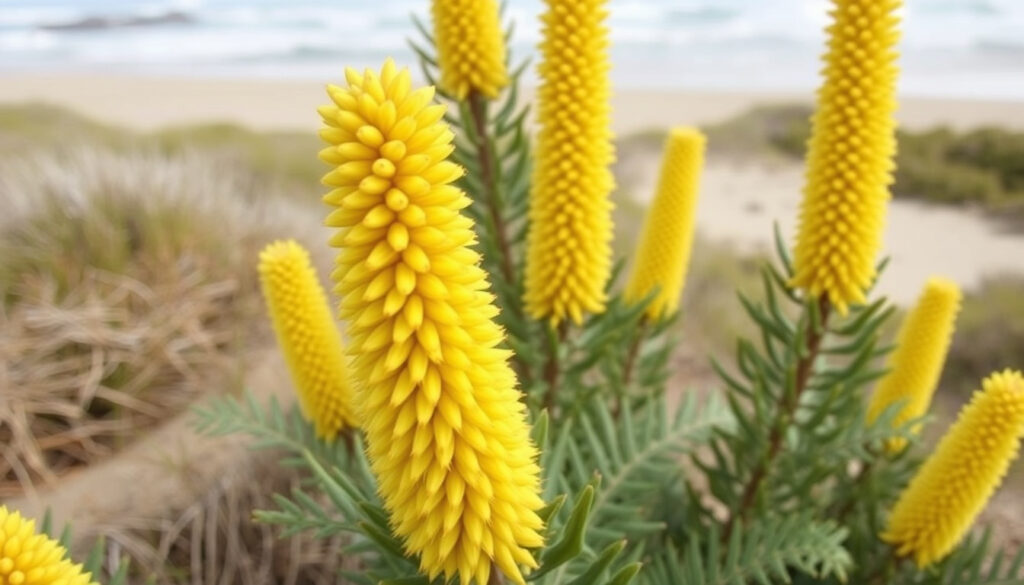
Banksia Integrifolia: Coast Banksia Care & Growth Guide
Few coastal gardens stay green without a fight — salt wind, sandy soil, and summer drought cull the weak. Banksia integrifolia is the plant that shrugs it off, and it does so while looking like a proper tree, not a scrappy survivor.
Height: 5–16 m (up to 25 m) ·
Growth rate: Moderate, 30–50 cm/year ·
Flower colour: Golden-yellow spikes ·
Foliage: Dark green with silvery-white undersides ·
Salt tolerance: High
Quick snapshot
- Coast Banksia grows as a tree or shrub roughly 5–25 m tall, depending on habitat and exposure (PlantNet NSW Flora Online (state herbarium database)).
- The species tolerates salt spray and coastal wind (Wikipedia (general reference)).
- It is distributed from Queensland to Victoria, including coastal and montane sites (Trees and Shrubs Online (botanical reference)).
- Exact growth rate varies with soil, water, and sun, so one published number does not fit every garden (Gardenia (plant care database)).
- Newly planted trees may need staking until the root system establishes (Promesse de Fleurs (ornamental nursery guide)).
- After roughly 2–3 years in open ground, routine summer watering is rarely needed except during drought (Promesse de Fleurs). (Promesse de Fleurs (ornamental nursery guide))
- Light pruning of young plants encourages a denser, more branched habit (Gardenia (plant care database)).
Seven facts, one pattern: this is a plant built for tough, well-drained sites, not for fussing.
| Attribute | Detail |
|---|---|
| Botanical name | Banksia integrifolia |
| Common name | Coast Banksia |
| Family | Proteaceae |
| Height | 5–16 m, up to 25 m in sheltered forest (PlantNet NSW Flora Online (state herbarium database)) |
| Growth rate | Moderate, roughly 30–50 cm per year (Gardenia (plant care database)) |
| Flower colour | Golden-yellow |
| Native range | Eastern Australia, Queensland to Victoria (Trees and Shrubs Online (botanical reference)) |
What does a Banksia tree look like?
Recognising a Coast Banksia is easier than you might think: the leaves are dark green on top and silvery-white underneath, and the golden flower spikes are impossible to miss.
Description of foliage and flowers
- Leaves are dark green above with silvery-white undersides (PlantNet NSW Flora Online).
- The flower spikes are golden-yellow and cylindrical, carried in the leaf axils (Trees and Shrubs Online).
Growth habit and bark
- In open coastal positions it is usually a tree or shrub 5–16 m tall; in sheltered forest it can reach 25 m (PlantNet NSW Flora Online (state herbarium database)).
- Bark is grey-brown and tesselated — corky and fissured.
- In exposed dunes it can stay low and shrubby (Trees and Shrubs Online (botanical reference)).
The implication: one species covers a huge visual range, from a wind-pruned coastal shrub to a 25 m forest tree — “what it looks like” depends almost entirely on where it grows.
Can Banksia be grown from cuttings?
Yes, but seed is the route most home gardeners take, because cuttings need more attention and a longer wait (Gardenia).
Best time for taking cuttings
- Semi-hardwood cuttings are the usual choice; take them from healthy, non-flowering stems.
Rooting hormone and medium
- Rooting hormone and a free-draining mix such as coarse sand and perlite improve the odds.
- Keep the medium moist but never waterlogged (Promesse de Fleurs (ornamental nursery guide)).
Aftercare for cuttings
- Maintain high humidity and warmth until roots form, then pot on gradually.
Step-by-step: growing from cuttings
- Select a semi-hardwood stem and cut just below a node.
- Remove the lower leaves and dip the base in rooting hormone.
- Insert into a mix of coarse sand and perlite.
- Mist and cover with a clear bag to keep humidity high.
- Keep in bright, indirect light and check for roots after 4–8 weeks.
- Pot on rooted cuttings and water regularly until established.
The catch: cuttings are a patience game. Fresh seed, on the other hand, is reported to germinate reliably and produce vigorous seedlings — so if you only want one or two plants, seed is the easier path.
Is Banksia integrifolia fast growing?
Moderate is the honest answer — this is not a bamboo-style speedster, but it is not painfully slow either.
Annual growth rate
- Under good conditions, expect roughly 30–50 cm of new growth per year (Gardenia).
- On poor, dry, or exposed sites, growth slows noticeably.
Comparison with other Banksia species
- Horticultural sources group it as a moderate grower, not a fast one.
- Its toughness makes it a more reliable choice for coastal plantings than quicker but less salt-tolerant species.
Factors affecting growth
- Full sun and well-drained soil are the two non-negotiables (Gardenia).
- Sandy, loamy, gravelly, and rocky soils all work if drainage is adequate (Gardenia).
- Waterlogged ground increases the risk of root problems (Promesse de Fleurs (ornamental nursery guide)).
A sheltered garden can turn a neat small tree into a 25 m specimen, so site choice matters more than any fertiliser or tonic.
The pattern: give it sharp drainage and sun, and you get steady, manageable growth. Push it into shade or wet clay, and you will wait years for the same height.
What are the different varieties of Banksia integrifolia?
Taxonomists currently recognise three subspecies, and the differences are mostly about geography and leaf shape.
Banksia integrifolia subsp. integrifolia
- The familiar Coast Banksia of coastal New South Wales and Victoria (Trees and Shrubs Online).
- Occupies coastal dunes, headlands, and woodland (Trees and Shrubs Online).
Banksia integrifolia subsp. compar
- The northern subspecies, recorded from Queensland (Trees and Shrubs Online).
Banksia integrifolia subsp. monticola
- A montane (highland) form that grows at higher altitudes (Wikipedia (general reference)).
The trade-off: for most gardens, the straight species is tough enough — subspecies mainly matter if you are collecting, breeding, or doing restoration work.
Do banksias like Seasol?
Seasol is the seaweed tonic many Australian gardeners reach for, and on banksias it has a clear role.
For a coastal block, this is the plant that keeps working when others crisp up: it tolerates salt, wind, and poor sandy soil, provided drainage is sharp.
Using Seasol on Banksia
- Liquid seaweed extract supports root health, especially while a young plant establishes.
- Follow the product’s label rates — more is not better.
Other fertilizers for Banksia
- Avoid high-phosphorus fertilizers; banksias are adapted to low-phosphorus soils (Wikipedia).
- Use a low-phosphorus native plant food if you feed at all.
Pruning dead flowers
- Dead flower spikes can be pruned to encourage new growth (Promesse de Fleurs).
- Remove dead, crossing, or poorly positioned branches while the plant is young (Gardenia).
Root system considerations
- Banksia roots are not typically invasive, but they are sensitive to disturbance.
- Stake newly planted trees until the root system establishes (Promesse de Fleurs).
Keeping Banksia small
- Yes, regular pruning keeps Banksia integrifolia at a manageable size (Promesse de Fleurs).
- Light pruning of young plants encourages a denser habit (Gardenia).
Eight rows, one message: the plant asks for sun and drainage, and gives back salt tolerance and steady growth in return.
| Aspect | Detail |
|---|---|
| Botanical name | Banksia integrifolia |
| Common name | Coast Banksia |
| Family | Proteaceae |
| Native range | Queensland to Victoria, Australia (Trees and Shrubs Online) |
| Height | 5–16 m, occasionally to 25 m (PlantNet NSW Flora Online) |
| Growth rate | Moderate, roughly 30–50 cm per year (Gardenia) |
| Flower colour | Golden-yellow spikes (PlantNet NSW Flora Online) |
| Foliage | Dark green above, silvery-white below (Trees and Shrubs Online) |
Confirmed facts
- Can be grown from cuttings, though seed is the more common route (Gardenia).
- Prefers full sun and well-drained soil (Gardenia).
- Grows across a wide range of habitats, from dunes to montane forest (Trees and Shrubs Online).
What’s unclear
- Salt-tolerant evergreen suitable for coastal gardens (Wikipedia (general reference)).
- Exact growth rate depends on local conditions (Gardenia).
- Ideal pruning time varies with climate and flowering season (Promesse de Fleurs).
- Long-term performance in heavy clay or very humid inland gardens is less documented than coastal performance.
“Banksia integrifolia is commonly known as coast banksia and can occur as a tree approximately 5–25 m tall, depending on habitat and exposure.”
PlantNet NSW Flora Online (state herbarium database)
“The species is distributed from Queensland through New South Wales and Victoria, including coastal sites and inland or montane areas.”
Trees and Shrubs Online (botanical reference)
“After approximately two or three years in open ground, an established plant may not need routine summer watering except during exceptional drought.”
Promesse de Fleurs (ornamental nursery guide)
The real decision is about space, not effort. Plant Banksia integrifolia where it can grow into a tree, and it will reward you with decades of salt-tolerant structure; plant it in a small garden and you can keep it compact, but only with a yearly pruning commitment. For the home gardener on a coastal block, the choice is clear: give it room to become a tree, or schedule an annual prune — there is no painless middle ground.
Related reading: Teddy Bear Magnolia: Size, Care, and Common Problems
Frequently asked questions
How long does Banksia integrifolia take to flower?
There is no fixed calendar, but the establishment period is a practical guide: young plants often focus on roots and shoots for the first 2–3 years, so the first strong flush of golden spikes usually appears after that phase in a sunny, well-drained spot.
Is Banksia integrifolia drought tolerant?
Once established, it copes well with dry coastal conditions and needs little supplementary watering. During inland heat or extended drought, an occasional deep watering helps it stay healthy.
Can Banksia integrifolia grow in shade?
It prefers full sun. In shade, growth slows and flowering is reduced, so choose the sunniest spot you have.
What soil type does Banksia integrifolia prefer?
Well-drained sandy, loamy, gravelly, or rocky soil. Permanently waterlogged ground is unsuitable and increases root problems.
How often should I water Banksia integrifolia?
Water regularly while the plant is young, then switch to deeper, less frequent watering. After 2–3 years in open ground, water mainly during exceptional drought.
Does Banksia integrifolia have invasive roots?
Its roots are not typically regarded as invasive, but they are sensitive to disturbance. Stake young trees and avoid digging close to the trunk.
Can Banksia integrifolia grow in a pot?
Yes, but container-grown plants need more regular watering than garden plants, and the pot must drain freely.
Related reading: Teddy Bear Magnolia: Size, Care, and Common Problems
More related posts
 Maggie Smith Dies at 89: Tributes, Illness, and Legacy
 Joanne Whalley: Career, Marriage to Val Kilmer, and Life Now
 Alex Consani: Age, Height, Pronouns, and Career Milestones
 Joe Ingles: NBA Journey, Family, Stats and Net Worth
 Dean Supernatural: Full Story of His Death and Relationships
 Nara Deer Park: Free Entry Costs, Hours & Visit Tips
 Greg Page Wiggles: Health Crisis, Departure & Comeback
 Sunny Deol: Health, Family, Career & Wealth Facts