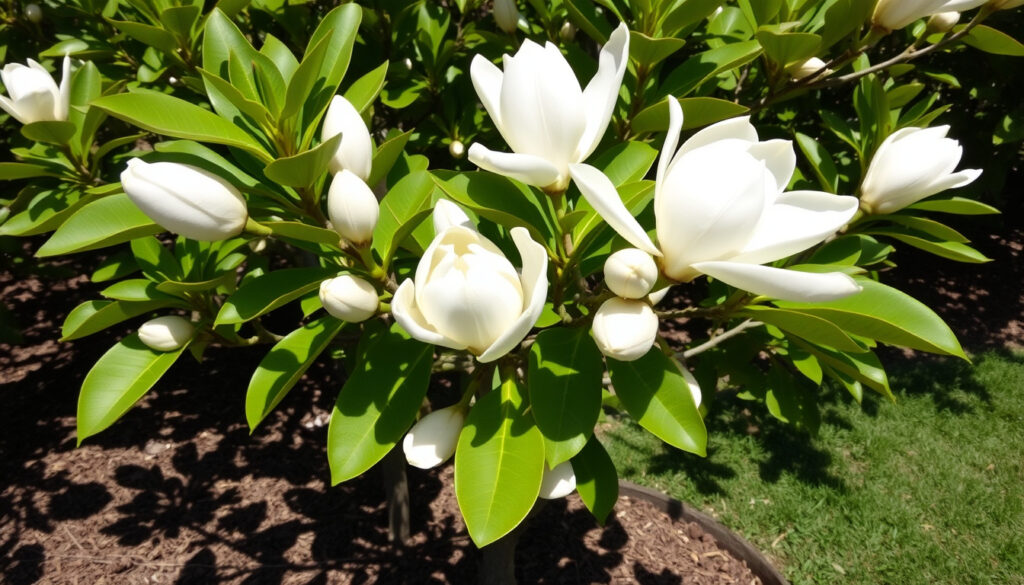
Teddy Bear Magnolia: Size, Care, and Common Problems
Anyone who’s fallen for a magnolia tree only to realize it will outgrow their entire front yard knows the frustration. The Teddy Bear Magnolia promises the same lush, evergreen beauty of a Southern magnolia in a package that actually fits smaller spaces.
Mature height: 12–20 ft (3.6–6 m) ·
Mature spread: 10–12 ft (3–3.6 m) ·
Growth rate: Moderate (1–2 ft per year) ·
Foliage: Evergreen, dark green with copper undersides ·
Scientific name: Magnolia grandiflora ‘Teddy Bear’ ·
USDA zones: 6–10 (typical for Southern magnolia)
Quick snapshot
- Mature height: 12–20 ft (Monrovia nursery)
- Mature width: 10–12 ft (Monrovia nursery)
- Growth rate: moderate (1–2 ft/year) (Monrovia nursery)
- Full sun to partial shade (Four Seasons Nursery)
- Well-drained, slightly acidic soil (Four Seasons Nursery)
- Regular watering; avoid soggy soil (Four Seasons Nursery)
- Specimen tree
- Informal hedge
- Container planting for patios
- Root rot from overwatering
- Scale insects
- Leaf spot in humid climates
| Attribute | Value |
|---|---|
| Botanical name | Magnolia grandiflora ‘Teddy Bear’ |
| Plant type | Evergreen tree |
| Mature height | 12–20 ft (3.6–6 m) |
| Mature width | 10–12 ft (3–3.6 m) |
| Sun exposure | Full sun to partial shade |
| Soil type | Moist, well-drained, acidic |
| Hardiness zones | 6–10 (USDA) |
| Foliage color | Dark green with copper-brown undersides |
| Bloom time | Late spring to summer (showy white flowers) |
How big will a teddy bear magnolia get?
This is the first question every gardener asks — and the answer depends heavily on which source you trust.
Typical height and spread
Monrovia, one of the most respected wholesale nurseries in the US, reports the Teddy Bear Magnolia reaches 16–20 ft tall and 10–12 ft wide at maturity. However, the LSU AgCenter, an .edu authority on Southern horticulture, describes the plant as topping out at 12 ft tall with a 10–12 ft spread. That 4–8 ft discrepancy is the single biggest point of confusion for buyers. The Australian market sees a tighter range: Bunnings, a tier-2 hardware and garden retailer, lists it at around 4 metres (13 ft) tall and 2.5 metres (8 ft) wide.
Factors affecting mature size
- Regional climate — warmer USDA zones (8–10) tend toward the higher end of the range
- Soil quality — rich, well-drained, slightly acidic soil encourages fuller growth
- Sunlight — at least 6 hours of direct sun per day is ideal
- Watering consistency — Teddy Bear performs best with regular, deep watering during establishment years
Growth rate compared to other magnolias
Teddy Bear grows at a moderate pace of about 1–2 ft per year under optimal conditions. That’s noticeably slower than Little Gem, which can push 2–3 ft annually. The trade-off is a denser, more compact form that requires less corrective pruning over the tree’s life.
Homeowners who choose Teddy Bear over faster growers like Little Gem sacrifice 2–3 years of vertical height but gain a tree that stays naturally bushy and rarely needs aggressive pruning to fit a tight space.
What are common problems with teddy bear magnolias?
Teddy Bear is a hardy plant, but humidity, poor drainage, and certain insects can cause trouble.
Pest issues: scales, aphids, and spider mites
- Scale insects are the most common pest on Southern magnolias. They appear as small, brownish bumps on stems and leaf undersides. Treat with horticultural oil in early spring before new growth emerges.
- Aphids and spider mites occasionally appear in dry, dusty conditions. A strong water spray or insecticidal soap usually handles them.
Diseases: leaf spot, powdery mildew, root rot
- Leaf spot — fungal spots on leaves, worsened by overhead watering. Improve air circulation and avoid wetting foliage.
- Powdery mildew — white powdery coating on leaves in humid, shaded spots. Prune to increase airflow.
- Root rot — the biggest danger. Overwatering or planting in heavy clay soil can kill the tree. Ensure soil drains well; add organic matter if needed.
Environmental stress: frost damage, nutrient deficiencies
In zones 6–7, late frosts can damage new growth and flower buds. Protect young trees with frost cloth during cold snaps. Yellowing leaves (chlorosis) may indicate iron deficiency in alkaline soils — a soil test can confirm, and an iron chelate supplement can correct it.
The most common Teddy Bear Magnolia failure is not disease — it’s planting in poorly drained soil. A tree that looks yellow and stunted is usually drowning, not starving. Check drainage before you water again.
The pattern across these problems: Teddy Bear is resilient when given the basic conditions it needs — good drainage, adequate sun, and moderate watering. Problems cluster around overcare (too much water, too much fertilizer) or neglect in the first two establishment years.
How to treat struggling magnolia teddy bear?
Before reaching for a spray or fertilizer, diagnose the real cause — the fix depends on the symptom.
Diagnosing the problem
- Yellowing leaves with green veins → likely iron chlorosis from alkaline soil
- Brown leaf edges, wilting → overwatering or root rot
- Yellow lower leaves dropping → normal aging, not a problem
- White powdery coating → powdery mildew from poor air circulation
- Sticky residue on leaves → scale or aphid infestation
Correct watering and drainage
Teddy Bear needs consistent moisture but absolutely cannot tolerate soggy roots. Water deeply once a week during the first two growing seasons, then taper as the tree establishes. If your soil is heavy clay, consider a raised bed or amending the planting hole with compost.
Fertilizing and soil amendments
Apply a balanced slow-release fertilizer (such as 10-10-10) in early spring. For iron chlorosis, apply iron chelate or soil sulfur to lower pH. Avoid heavy fall fertilization, which can stimulate tender growth before frost.
Pruning damaged branches
Remove dead, diseased, or crossing branches in late winter before new growth begins. Because Teddy Bear has a naturally dense, conical form, pruning should be minimal — only what’s necessary for structure and health.
What is the difference between little gem and teddy bear magnolia tree?
These are the two most popular compact Southern magnolia cultivars, and many gardeners pick between them. The differences matter for your space and maintenance expectations.
Five key specs, one clear trade-off:
| Feature | Teddy Bear | Little Gem |
|---|---|---|
| Typical mature height | 12–20 ft (3.6–6 m) | 15–35 ft (4.5–10.7 m) |
| Typical mature spread | 10–12 ft (3–3.6 m) | 8–15 ft (2.4–4.5 m) |
| Growth rate | Moderate (1–2 ft/yr) | Fast (2–3 ft/yr) |
| Leaf size & color | Darker green, copper undersides, broader leaves | Smaller, narrower leaves |
| Form | Dense, conical, compact | Pyramidal, more upright |
| Best for | Tight spaces, containers, hedges | Screening, larger yards |
The catch: Little Gem’s faster growth and taller potential make it a better privacy screen for a larger yard, but it will require more pruning discipline and eventual space. Teddy Bear’s smaller stature and slower growth mean less maintenance and a safer fit near foundations.
A homeowner planting a “compact” tree that quietly reaches 35 ft is a common regret. Teddy Bear’s upper end (20 ft) is still manageable for most suburban lots; Little Gem at 35 ft becomes a dominant landscape feature that can overwhelm a small garden.
How quickly does teddy bear magnolia grow?
Growth rate is moderate — roughly 1–2 ft per year, as reported by Monrovia and confirmed across multiple nursery sources. This makes Teddy Bear about 30–50% slower than the standard Southern magnolia or Little Gem.
Average annual growth
In ideal conditions (full sun, consistent moisture, fertile acidic soil), expect 1.5–2 ft of vertical growth per year for the first 5–7 years. After that, growth slows as the tree approaches its mature height. A 5-year-old Teddy Bear in good soil should be around 7–10 ft tall.
Factors influencing growth speed
- Sunlight: full sun (6+ hours) is non-negotiable for optimal growth. Less sun means slower, leggier growth.
- Soil: well-drained, sandy loam with organic matter outperforms heavy clay by a wide margin.
- Water: consistent moisture in the first two years is critical; after establishment, the tree is moderately drought-tolerant.
- Competition: grass and shallow-rooted ground covers compete with the magnolia’s feeder roots; a mulch ring around the base helps.
Comparison with other magnolia cultivars
Teddy Bear is noticeably slower than Little Gem (2–3 ft/year), but faster than truly dwarf ornamental trees like crape myrtle varieties. The moderate speed is actually a benefit: slower annual growth means denser branching and a more compact shape that needs less pruning.
Related reading: Crepe Myrtle · Glass Sliding Door Guide
thespruce.com, gardenia.net, bindy.com.au, youtube.com, fast-growing-trees.com, ultimatebackyard.com.au, trees.com, south-florida-plant-guide.com, plantglossary.com, burkesbackyard.com.au, shop.pikenursery.com
Frequently asked questions
How much water does a teddy bear magnolia need?
During the first 2 growing seasons, water deeply once a week (about 1–2 inches per week). Once established, Teddy Bear is moderately drought-tolerant and only needs supplemental water during extended dry periods.
What is the best fertilizer for teddy bear magnolia?
A balanced slow-release fertilizer like 10-10-10 applied in early spring works well. If soil is alkaline, supplement with iron chelate to prevent chlorosis. Avoid high-nitrogen fertilizers, which promote weak growth.
When should I prune a teddy bear magnolia?
Late winter, before spring growth begins, is the best time. Pruning is minimal — remove only dead, damaged, or crossing branches. The tree’s natural dense form doesn’t need shaping.
Can teddy bear magnolia grow in a container?
Yes. With its compact, slow-growing habit, Teddy Bear is one of the best magnolias for container growing. Use a large pot (24+ inches) with good drainage, and repot every 3–4 years.
Is teddy bear magnolia deer resistant?
Southern magnolias, including Teddy Bear, are generally considered deer-resistant because of their leathery leaves. However, hungry deer may browse young growth in winter.
Does teddy bear magnolia need full sun?
Teddy Bear performs best in full sun (at least 6 hours of direct sunlight daily). It will tolerate partial shade but will grow slower and may develop a looser, less dense canopy.
How to protect a teddy bear magnolia from frost?
In USDA zones 6–7, apply a 3–4 inch layer of mulch around the root zone (not touching the trunk) and wrap the tree with frost cloth when temperatures drop below 20°F. Young trees are most vulnerable in their first 2–3 winters.
For Australian shoppers, the choice between Teddy Bear and Little Gem comes down to a single decision: do you have a 4-metre-wide planting space, or a 6-metre-plus space? In the former, Teddy Bear is the overwhelming favourite. In the latter, Little Gem’s faster growth and taller form will earn its keep as a screen. Either way, your magnolia will reward you with glossy evergreen leaves and fragrant white blooms — if you give it the right start.
More related posts
 Banksia Integrifolia: Coast Banksia Care & Growth Guide
 Fantastic Furniture Cairns: Location, Hours & Products
 Kia Carnival: Seating, UK Availability, Cost & Reliability
 Lizzie Borden: The Real Story of the Axe Murders and Acquittal
 Harli and Harpa: Lawsuit, Quality Concerns & Brand Meaning
 Photo Frames Ireland: Where to Buy, Sizes & Best Stores
 What is a Halal Snack Pack? History, Ingredients & Facts
 Go Card Login QLD: Official TransLink Guide and Steps