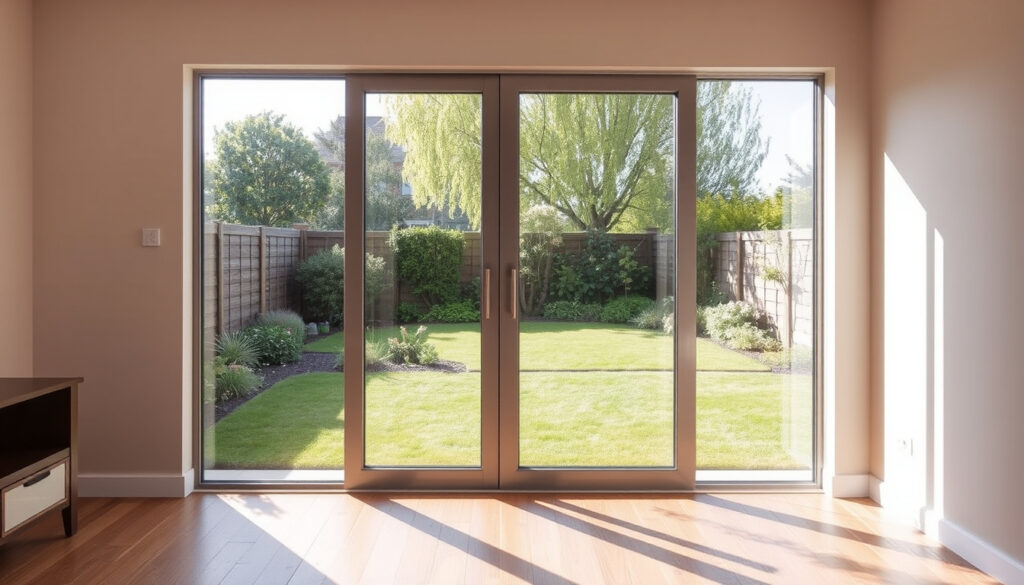
Glass Sliding Door Guide: Pros, Cons, Costs & Installation
A glass sliding door can transform a room, flooding it with light and opening up a view, but anyone who’s owned one for more than a year has a story about a stuck track or a drafty seal. The trade-off between that clean, open look and the practical demands of maintenance and security is real.
Average Installation Cost: $800 – $1,200 ·
Standard Width Range: 60 to 72 inches ·
Typical Lifespan: 20–30 years ·
Most Common Problem (track/roller): 45% of service calls ·
Energy Efficiency (U-factor): 0.30 – 0.60 ·
Glass Requirement: Tempered safety glass (ANSI Z97.1)
Quick snapshot
- Sliding doors save floor space by eliminating swing radius (Brennan Enterprises (door manufacturer))
- Double glazing is standard in most new installations (U.S. Department of Energy (federal agency))
- Track maintenance is necessary for smooth operation (This Old House (home improvement authority))
- Exact return on investment varies by region and real estate market
- Long-term durability depends heavily on climate and maintenance habits
- Impact of DIY installation on manufacturer warranty is case-dependent
- No specific timeline data available for sliding glass door developments
- Growing interest in triple-glazed sliding doors for better thermal performance
- Smart lock integration becoming more common in newer models
Seven key specs, one takeaway: sliding glass doors are as much about their framing and glass as they are about the price tag.
| Specification | Typical Value | Source |
|---|---|---|
| Average Installation Cost | $800 – $1,200 | HomeAdvisor (home services platform) |
| Full Project Range | $336 – $8,991 | HomeAdvisor |
| Labor Cost (per hour) | $70 – $100 | HomeAdvisor |
| Standard Width Range | 60 to 72 inches | ENERGY STAR (federal program) |
| Standard Height | 80 inches | ENERGY STAR (federal program) |
| Typical Lifespan | 20–30 years | This Old House (home improvement authority) |
| Energy Efficiency (U-factor) | 0.30 – 0.60 | U.S. Department of Energy (federal agency) |
| Glass Requirement | Tempered safety glass (ANSI Z97.1) | International Code Council (building code authority) |
| Frame Material Options | Aluminum, vinyl, wood, fiberglass | ENERGY STAR (federal program) |
| Hinged Door Price Premium | ~20% more than sliding doors | Brennan Enterprises (door manufacturer) |
What are the disadvantages of sliding glass doors?
For all their visual appeal, sliding glass doors bring a handful of headaches that owners routinely face. The most frequent issue — track and roller problems — accounts for nearly half of all service calls, according to HomeAdvisor (home services platform).
Track and roller issues
- Debris buildup in the bottom track is the primary cause of sticking and misalignment. A This Old House (home improvement authority) guide notes that regular track cleaning can extend door life by years.
- Rollers wear down over time, especially on heavier doors, leading to the door scraping the frame.
- Adjusting rollers is possible on most models but requires a screwdriver and patience.
Energy efficiency concerns
- Sliding doors typically have higher air leakage than hinged doors because the sliding panel’s weatherstripping is less forgiving of misalignment. The U.S. Department of Energy (federal agency) notes that proper sealing is critical for thermal performance.
- Single-glazed units are still found in older homes and perform poorly; double glazing is now standard under most building codes.
- U-factors of 0.30 to 0.60 mean performance varies widely — not all sliding doors are equal in insulation value.
Security vulnerabilities
- Standard sliding door locks use a simple latch that can be lifted off the track with a crowbar. NerdWallet (personal finance resource) lists custom security upgrades from $20 to $700.
- Adding a secondary lock or a security bar is a common recommendation from police departments across the U.S.
Sealing and weatherproofing problems
- Condensation can form between panes when the seal fails, requiring a full replacement of the glass unit.
- Drafting around the sash is common on older doors; replacing weatherstripping every 5–10 years is recommended.
Space limitations for curtains and blinds
- Because the door slides horizontally, standard vertical blinds or curtains can obstruct the track or get caught in the sliding panel.
- Built-in blinds are available but add $150 to $400 to the cost, per NerdWallet (personal finance resource).
Homeowners who prioritize open views face a recurring chore: track cleaning and seal inspection every season. That 45% service-call statistic means nearly half of all owners run into trouble where they least expect it.
The implication: track and seal maintenance is the price of natural light and open views.
Are sliding glass doors worth it?
The decision isn’t binary. For homes that face a garden, deck, or scenic view, a sliding door delivers visual value that a solid wall never can. But the costs — both upfront and ongoing — need to be weighed honestly.
Cost vs. value analysis
- Professional installation averages $800 to $1,200 for a standard two-panel unit, according to HomeAdvisor (home services platform). Total project costs can climb to $2,564 on average when site conditions add complexity.
- Adding a new opening in a wall can add $1,000 to $3,600 before the door itself, as reported by APRO (door supply company).
Aesthetic benefits
- Sliding doors eliminate the need for a swing radius, making small rooms feel larger.
- Uninterrupted glass panels provide panoramic views that hinged doors cannot match.
Energy savings considerations
- Natural light gains can reduce lighting costs during daylight hours.
- High-performance sliding doors with low-E coatings and double glazing can perform as well as standard windows when properly sealed.
Long-term maintenance costs
- Annual maintenance averages $100 to $200, including cleaning, lubrication, and weatherstripping replacement.
- Roller replacement runs $30 to $100 per set, depending on door weight.
Resale value impact
- Homes with sliding doors often sell faster in warm climates where indoor-outdoor flow is valued. However, no national data set shows a uniform premium.
For a homeowner who uses their patio daily, the $800–$1,200 upfront cost pays back in convenience and enjoyment within a couple of years. For someone in a cold climate with poor sealing, the energy penalty may cancel the pleasure.
The catch: the payoff depends entirely on how often you use the door and your climate.
What is a standard sliding glass door?
Sliding glass doors come in predictable sizes and configurations, but “standard” still leaves room for variation depending on the manufacturer and building code requirements.
Standard widths and heights
- The most common width for a two-panel sliding door is 60 to 72 inches. Three-panel doors can span up to 108 inches.
- Standard height is 80 inches, though custom heights are available.
Single vs. double glazing
- Double glazing is now mandatory in most new installations under building energy codes, per International Code Council (building code authority).
- Triple glazing is available in premium models but adds 30–50% to the door cost.
Frame materials: aluminum, vinyl, wood
- Aluminum frames are the most common and least expensive but conduct heat, making them less energy-efficient.
- Vinyl frames offer better insulation and are virtually maintenance-free.
- Wood frames provide the best aesthetic for traditional homes but require periodic painting or staining.
Tempered glass requirements
- Building codes in the U.S. and many other countries require tempered (safety) glass for sliding doors under standards like ANSI Z97.1.
- Tempered glass breaks into small, blunt pieces rather than sharp shards, reducing injury risk.
Typical configurations
- 2-panel: one fixed, one sliding — the most common configuration.
- 3-panel: one or two sliding panels for wider openings.
- Pocket doors: slide into a wall cavity, opening the entire opening (requires wall space and structural planning).
The implication: standard sizes fit most rough openings, but custom orders can double lead times and costs.
Why do Japanese houses use sliding doors?
The Japanese tradition of sliding doors, known as fusuma and shoji, offers lessons in space efficiency and light diffusion that modern sliding glass doors borrow directly.
Historical roots in shoji and fusuma
- Shoji doors use translucent paper stretched over a wooden lattice, diffusing light softly while maintaining privacy.
- Fusuma are opaque sliding panels used to divide rooms, allowing flexible floor plans.
Space-saving in small homes
- Sliding doors require no swing radius, a critical advantage in small Japanese rooms where every square foot counts.
- Traditional homes often have minimal furniture; sliding doors enable the entire room to open to a garden.
Connection between indoor and outdoor
- The engawa (veranda) acts as a transitional space, and sliding doors blur the boundary between interior and exterior.
- Modern Japanese homes still use sliding doors for patios, now with thermal glass and weatherstripping.
Natural materials and aesthetics
- Wood and paper create a warm, organic feel that contrasts with glass and aluminum.
- Modern adaptations often combine traditional sliding mechanics with energy-efficient glazing.
What this means: the Japanese approach prioritizes spatial flexibility and light quality over absolute security or insulation — a trade-off that works in mild climates and tiny lots.
Can you install a sliding glass door yourself?
For the handy homeowner, installing a pre-hung sliding door is possible, but the margin for error is small. A misaligned rough opening leads to air leaks, sticking, and early frame failure.
- Prepare the rough opening – Ensure it is square within 1/4 inch diagonally and level across the sill. Framing modifications can add $1,000 to $3,600 in contractor costs.
- Set the track level – The bottom track must be perfectly level; otherwise water will pool.
- Install the door panels – Glass panels are heavy (50–100 lbs) and require at least two people to lift safely.
- Adjust the rollers – Use the bottom adjustment screw; do not overtighten to avoid cracking the glass.
- Seal around the frame – Proper sealing is critical to prevent air and water leaks, which void most warranties.
Required tools and skills
- Basic tools: level, tape measure, drill, shims, caulk gun, helper.
- Skills needed: reading a level, cutting shims, adjusting door rollers.
- Safety note: glass panels are heavy (50–100 lbs) and require at least two people to lift without breaking.
Preparing the rough opening
- The opening must be square to within 1/4 inch diagonally, and level across the sill.
- Framing modifications, if needed, can add $1,000 to $3,600 in contractor costs, per HomeAdvisor (home services platform).
Installing the track and door panels
- The bottom track must be set perfectly level or water will pool.
- Rollers are adjusted from a bottom screw — overtightening can crack the glass.
Finishing and sealing
- Proper sealing around the frame is critical. Improper sealing leads to air and water leaks, voiding most warranties.
When to hire a professional
- Manufacturers like Brennan Enterprises (door manufacturer) recommend professional installation to maintain warranty coverage.
- If the opening requires structural changes or if the existing wall has electrical or plumbing, hire a pro.
How do sliding glass doors compare to hinged patio doors?
The choice between sliding and hinged doors is one of the oldest debates in home design. Each has clear strengths and trade-offs that depend on your space, budget, and priorities.
Space requirements
- Sliding doors require zero exterior or interior swing space, making them ideal for decks, small patios, or rooms with furniture near the wall.
- Hinged doors need 2–3 feet of clearance for the swing arc.
Weather sealing
- Hinged doors typically have thicker weatherstripping and a compression seal, resulting in lower air leakage.
- Sliding doors rely on brush or pile weatherstripping that can wear out and allow drafts.
Ease of use
- Sliding doors are harder to operate when tracks are dirty or rollers worn — the 45% service-call statistic reflects this.
- Hinged doors open and close with a simple pull and push, regardless of track condition.
Cost differences
- Sliding doors are generally about 20% cheaper than hinged French or patio doors of comparable size and material, per industry pricing data.
- For a standard 72-inch opening, a sliding door installed runs $800–$1,200, while hinged doors start around $1,200.
Aesthetic preferences
- Sliding doors offer an uninterrupted view, making them the top choice for scenic backyards.
- Hinged doors provide a classic, symmetrical look that some homeowners prefer for traditional architecture.
The trade-off: if you have the clearance and a higher budget, hinged doors offer better sealing and simpler operation. If space is tight or the view is the selling point, sliding doors win.
Sliding vs. Hinged: Detailed Comparison
Three key differences, one pattern: sliding doors prioritize space and view; hinged doors prioritize sealing and security.
| Feature | Sliding Glass Door | Hinged Patio Door |
|---|---|---|
| Swing space required | None | 2–3 ft |
| Weather seal type | Brush/pile (sliding friction) | Compression (positive seal) |
| Air leakage rate | Higher (more draft-prone) | Lower (tighter seal) |
| Cost (installed, 72″) | $800–$1,200 | $1,200–$2,000 |
| Ease of operation | Can stick; rollers need adjustment | Consistent, simple pull/push |
| View obstruction | Minimum (wide glass) | Divided lites possible |
| Security (out-of-box) | Weaker (liftable latch) | Stronger (deadbolt-ready) |
| Maintenance frequency | Track cleaning every 3 months | Hinge lubrication yearly |
The pattern: the choice is a clear spatial trade-off against sealing and security.
Pros & Cons of Sliding Glass Doors
Upsides
- Saves floor space — no swing radius needed
- Uninterrupted panoramic views
- Generally 20% cheaper than hinged doors
- Allows indoor-outdoor flow in warm weather
- Easy to open and close when track is clean
Downsides
- Higher air leakage and draft potential
- Tracks and rollers require regular cleaning
- Less secure out-of-the-box latch
- Condensation and seal failure possible
- Furniture can block full opening
Maintenance: What Owners Should Know
Keeping a sliding glass door running smoothly isn’t complicated, but neglect is the main reason doors fail before their time.
- Clean tracks monthly: Use a vacuum and a damp cloth to remove dirt that accumulates.
- Lubricate rollers and track: Use silicone spray (not oil, which attracts grit).
- Adjust rollers: If the door scrapes, most models have an adjustment screw at the bottom.
- Replace weatherstripping: Every 5–10 years, or when drafts appear.
- Check for seal failure: If condensation appears between panes, the sealed unit needs replacement.
A homeowner who skips track cleaning for one season increases the risk of roller damage — and a roller replacement costs about $50 per set. That small chore pays for itself in door longevity.
The implication: a few minutes of seasonal care prevents costly repairs later.
Repair: Common Problems and Fixes
Most sliding door problems are fixable without replacing the entire unit. Here are the most common issues and their solutions.
Door won’t slide smoothly
- Clean the track and lubricate. If still sticky, check rollers for wear — replace if flattened.
Door is misaligned
- Adjust the roller height from the bottom screw. Raise both sides until the door rolls evenly.
Air leaks around the door
- Replace the weatherstripping. This is a $10–$20 repair that can reduce drafts significantly.
Lock is broken or insecure
- Replace with a reinforced lock or add a security bar. NerdWallet (personal finance resource) notes custom locks range from $20 to $700.
The pattern: most repairs cost under $100 and take an hour. The two exceptions — a broken sealed glass unit or a warped frame — typically require full replacement.
“Regular track cleaning can extend door life by years.”
— This Old House (home improvement authority)
“45% of sliding door service calls are for track alignment issues.”
— HomeAdvisor (home services platform)
Summary: A glass sliding door is a design win that comes with a maintenance contract. For homeowners who treat track cleaning as a seasonal ritual and budget for an occasional roller or seal replacement, the trade-off is worth it. For those who want zero upkeep, a hinged door or a solid wall may be the better bet. For the buyer in a warm climate with a view to show off, the choice is clear: embrace the sliding door, clean the track, and enjoy the light.
swingingcafedoors.com, homewyse.com, bayviewwindows.ca, yelp.com, ticcolorado.com, youtube.com, sunseekerdoors.co.uk, windowhub.us
Frequently asked questions
How to clean sliding glass door tracks?
Use a vacuum with a narrow attachment to remove debris, then wipe the track with a damp cloth. For stubborn grime, use a small brush or an old toothbrush. Lubricate with silicone spray afterward.
What is the best type of glass for sliding doors?
Tempered safety glass meeting ANSI Z97.1 is required by building codes. Double glazing with low-E coating is recommended for energy efficiency.
Do sliding glass doors increase home value?
They can in warm climates where indoor-outdoor living is desired, but the impact is regional. No national data shows a consistent premium.
Can sliding glass doors be double glazed?
Yes. Double glazing is standard in most new sliding door installations. It improves energy efficiency and reduces condensation.
How to adjust sliding door rollers?
Locate the adjustment screw at the bottom edge of the door (often behind a plastic plug). Turn clockwise to raise the door, counterclockwise to lower it. Adjust both sides equally.
Are sliding glass doors secure?
Standard latches are less secure than hinged door locks. Adding a secondary lock or security bar is recommended for ground-floor installations.
What is the average price of a sliding glass door?
Professional installation averages $800 to $1,200 for a standard two-panel unit. Total project costs can range from $336 to $8,991 depending on size and site conditions, per HomeAdvisor (home services platform).
How do sliding doors compare to French doors?
Sliding doors save space and cost about 20% less, but French doors offer a tighter seal and more traditional style. Choose based on space and aesthetic priority.
Related reading: Range Hood Guide 2025: Ducted vs Ductless, Cost, and Installation · Towel Rail Guide: Heated vs Standard & Selection Tips
More related posts
 Food Near Me Open Now: Ireland Delivery & Takeaway Guide
 Butter Cream Icing – Guide to Smooth Stable Frosting
 DJ Qualls: Health, Partner, and Career Facts
 Ilia Topuria: Undefeated Champion, Record & Next Fight
 Chase Infiniti Biography: Real Name, Ethnicity, Career
 Silvia Colloca: Biography, Family, and Career
 Terence Tao: IQ, Achievements, Net Worth & Biography
 Squid Game Season 3 Release Date – June 27, 2025 Confirmed