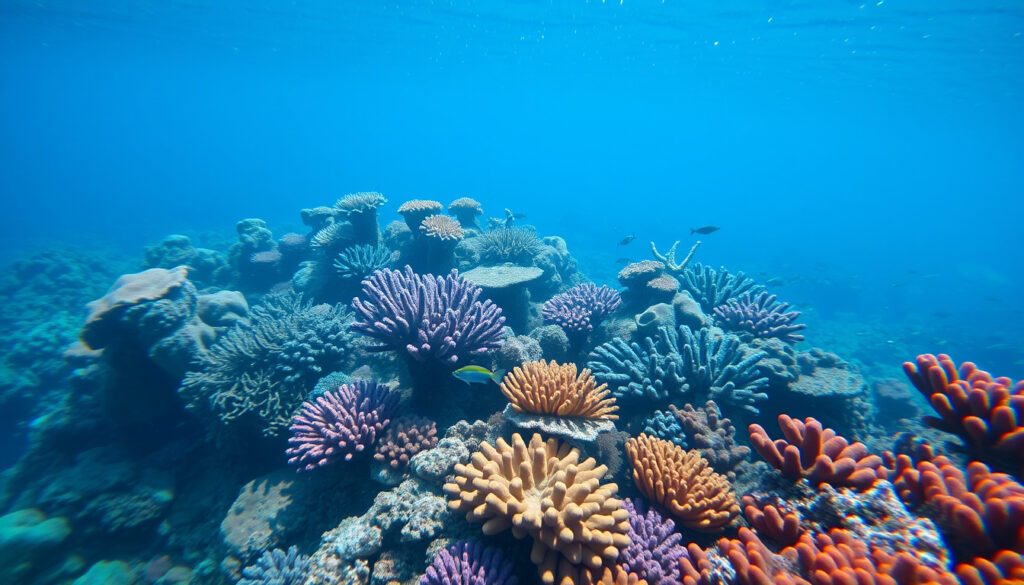
Coral Reef: Definition, Types, Importance and Why You Shouldn’t Touch
When you picture a coral reef, you might think of a tropical postcard — but these ancient cities of the sea are far more than a pretty backdrop. Built by tiny animals called polyps, coral reefs shelter 25% of all marine life and protect coastlines from storms.
Coral reefs cover less than 1% of the ocean floor: 0.1% · Marine species supported by coral reefs: 25% · Estimated annual economic value of coral reefs globally: $375 billion
Quick snapshot
- Underwater ecosystem built by coral polyps (NOAA Ocean Service)
- Made of calcium carbonate skeletons (NOAA Ocean Service)
- Home to 25% of marine life (NOAA Ocean Service)
- Fringing reefs (Coral Reef Alliance)
- Barrier reefs (Coral Reef Alliance)
- Atolls (Coral Reef Alliance)
- Patch reefs (Coral Reef Alliance)
- Protect coastlines from storms
- Support fishing and tourism
- Source of new medicines
- Climate change and bleaching
- Pollution and overfishing
- Physical damage from touching
Six key facts that capture the essentials of coral reef ecosystems today.
| Fact | Value |
|---|---|
| Definition | Underwater ecosystem of reef-building corals (NOAA Florida Keys National Marine Sanctuary) |
| Building material | Calcium carbonate secreted by polyps (NOAA Ocean Service) |
| Number of types | 4 (fringing, barrier, atoll, patch) (Coral Reef Alliance) |
| Global coverage | Less than 1% of ocean floor |
| Biodiversity supported | 25% of all marine species |
| Economic value | $375 billion per year |
The table makes clear: coral reefs punch far above their weight in ecological and economic terms.
What exactly is a coral reef?
A coral reef is an underwater ecosystem characterized by reef-building corals. These living structures are formed of colonies of coral polyps held together by calcium carbonate skeletons that they secrete. Unlike rocks, coral reefs are built by tiny, soft-bodied animals that extract calcium from seawater to create hard, protective homes. The NOAA Ocean Service (U.S. government ocean agency) defines coral reefs as “one of the most diverse ecosystems on Earth.”
Definition of a coral reef
- Coral reefs are living, growing structures (NOAA Florida Keys National Marine Sanctuary)
- Reefs form in shallow, sunlit tropical waters and also in cold deep waters
- Polyps build the reef layer by layer over thousands of years
How coral reefs are built by polyps
- A polyp is a tiny, sac-like animal with a mouth surrounded by tentacles
- Polyps secrete a hard exoskeleton of calcium carbonate (Encyclopaedia Britannica (science reference))
- As polyps die, new polyps build on top, growing the reef upward
Coral polyps are the architects of underwater cities. Each generation adds a new floor to the reef, creating complex three-dimensional habitats that shelter fish, crustaceans, and countless other species.
The implication: every coral reef is a living archive of thousands of years of construction by creatures smaller than a fingernail.
What are the 4 types of coral reefs?
Scientists generally group coral reefs into four principal forms. The Coral Reef Alliance (coral conservation organization) describes these as fringing reefs, barrier reefs, atolls, and patch reefs. Britannica adds that platform reefs are sometimes used as another term for patch reefs.
Fringing reefs
- Fringing reefs grow directly from the shore (Coral Reef Alliance)
- They are the most common type of reef
- Separated from the shore by narrow, shallow lagoons
Barrier reefs
- Barrier reefs run parallel to the coastline, separated by deeper, wider lagoons (Coral Reef Alliance)
- At their shallowest points they can reach the water’s surface, creating a navigational hazard
- The Great Barrier Reef is the world’s largest barrier reef system
Atolls
- Atolls are ring-shaped coral formations that enclose a central lagoon (Encyclopaedia Britannica (science reference))
- They form when islands surrounded by fringing reefs sink or sea level rises (Coral Reef Alliance)
- Atolls are usually found in the middle of the ocean, far from land
Patch reefs
- Patch reefs are small, isolated reefs that grow from the open bottom of an island platform or continental shelf (Encyclopaedia Britannica (science reference))
- They rarely reach the water’s surface
- Found between fringing reefs and barrier reefs, or inside atoll lagoons
For divers and coastal planners, the distinction matters: fringing reefs are accessible from shore, barrier reefs require a boat crossing a lagoon, atolls are remote oceanic rings, and patch reefs are hidden gems that often host the highest biodiversity per square meter.
The pattern: each reef type represents a different relationship to land and depth, from shoreline fringes to open-ocean rings.
Why shouldn’t you touch a coral reef?
Touching a coral reef is harmful both to the reef and to you. The reasons range from biological vulnerability to legal protections.
Damage to the coral’s protective mucus layer
- Corals are covered in a thin mucus layer that protects them from disease and UV radiation (Coral Reef Alliance)
- Even a light touch can damage or remove this protective layer, leaving the coral vulnerable to infection
- Damage can take years to heal
Risk of infection to humans
- Coral can cause cuts that easily become infected
- Some corals have sharp edges and may contain bacteria or toxins
- Stinging cells (nematocysts) in certain corals can cause skin irritation
Legal protections for coral reefs
- In many countries, coral reefs are protected by law
- Fines for damaging coral can be thousands of dollars
- Encyclopaedia Britannica (science reference) notes that reef ecosystems are often designated as marine protected areas
The same mucus layer that makes coral slimy to the touch is its immune system. Once that barrier is broken, bacteria and algae can invade, triggering coral bleaching or death. For the reef, a single careless touch can be a death sentence.
The catch: what feels like a harmless brush to a human can be a fatal wound to a coral colony.
Are there any coral reefs in Ireland?
Yes, Ireland has cold-water coral reefs. Unlike the sun-warmed tropical reefs most people imagine, these reefs thrive in deep, dark waters off the continental shelf.
Cold-water coral reefs off the Irish coast
- Cold-water corals such as Lophelia pertusa form reefs in waters 200–1,000 metres deep
- Notably, the Darwin Mounds and the Porcupine Bank are sites of large cold-water coral provinces west of Ireland (Encyclopaedia Britannica (science reference))
- These reefs support unique deep-sea communities
Deep-sea coral species found in Irish waters
- Lophelia pertusa is the main reef-building coral in Irish cold-water reefs
- Other species include Madrepora oculata and Solenosmilia variabilis
- These reefs are protected under the EU Habitats Directive
Ireland’s cold-water reefs are among the most northerly reef ecosystems in the world. While they avoid the bleaching threat of tropical reefs, they are vulnerable to deep-sea trawling and ocean acidification.
What this means: Ireland hosts a hidden reef world that needs different conservation strategies than tropical systems.
What is another name for a coral reef?
Depending on the context, coral reefs go by several names. A common crossword clue for a circular coral reef is “atoll” (5 letters). Other terms include “coral bank” and “reef”.
Common synonyms and crossword clues
- “Atoll” is the most frequent 5-letter word for a ring-shaped coral reef (Encyclopaedia Britannica (science reference))
- “Patch reef” is used for small isolated reef structures
- “Barrier reef” refers specifically to large offshore reefs separated from land
Circular coral reef (5) crossword answer
- The answer is almost always “atoll”
- Atolls are defined as “ring-shaped coral reefs that enclose a lagoon” (Coral Reef Alliance)
The implication: if you’re stuck on a crossword clue asking for a circular coral reef, you now have the answer — and the science behind it.
“Coral reefs are the rainforests of the sea — they cover less than 1% of the ocean floor but support 25% of all marine life.”
NOAA Ocean Service (U.S. government ocean agency)
“Many of the world’s reefs are already severely degraded by climate change, pollution, and overfishing.”
Coral Reef Alliance (coral conservation organization)
“Cold-water coral reefs are a hidden treasure — they provide habitat for deep-sea fish and invertebrates.”
ORCA Ireland (marine conservation group)
For Ireland’s coastal communities, the choice is clear: protect these fragile cold-water reefs from destructive trawling, or risk losing an irreplaceable part of the Atlantic ecosystem.
Confirmed facts
- Coral reefs are built by coral polyps (NOAA Ocean Service)
- There are 4 main types of coral reefs (Coral Reef Alliance)
- Touching coral damages its protective layer (Coral Reef Alliance)
- Ireland has cold-water coral reefs (Encyclopaedia Britannica)
What’s unclear
- Exact number of undiscovered coral reef species
- Long-term recovery rates for damaged reefs after bleaching events
reefresilience.org, coralreef.noaa.gov, dresseldivers.com, coralreefwatch.noaa.gov, pressbooks.pub, coralvita.co, obis.org, youtube.com
Frequently asked questions
How do coral reefs form?
Coral reefs form over thousands of years as generations of coral polyps secrete calcium carbonate skeletons. The reef grows upward toward sunlight and outward from the shore.
What is coral bleaching?
Coral bleaching happens when corals expel the symbiotic algae living in their tissues due to stress from warm water or pollution, causing them to turn white and become vulnerable to disease.
How deep are coral reefs?
Most tropical coral reefs grow in shallow water less than 50 metres deep. Cold-water coral reefs can occur at depths of 200 to 1,000 metres.
What animals live in coral reefs?
Coral reefs support a vast range of life including fish, crustaceans, mollusks, sea turtles, sharks, and countless invertebrates. Up to 25% of all marine species depend on reefs.
How can I help protect coral reefs?
Use reef-safe sunscreen, avoid touching coral while snorkeling, reduce your carbon footprint, support marine protected areas, and choose sustainable seafood.
What is the difference between warm-water and cold-water coral reefs?
Warm-water reefs thrive in shallow tropical seas and depend on symbiotic algae. Cold-water reefs grow in deep, dark waters and do not require sunlight; they feed by filtering plankton.
Related reading: Types of Coral Reef Formations · Coral Reef Classification Guide
More related posts
 Best Karaoke Songs: Top Picks for Every Skill Level and Crowd
 Emma Naomi: Professor T Exit, Bridgerton Role & More
 Scooby-Doo: Characters, LGBTQ Milestone & British Slang
 Jessica Fox’s Kidney Surgery Recovery and Return to Competition
 Melissa Fumero: Brooklyn Nine-Nine Star’s Life and Career
 Asher Keddie: Lupus, Scarves, Children, and Career
 Sean Connery: Biography, Net Worth, Cause of Death & Legacy
 Virgin Money Login – Secure Account Access Guide