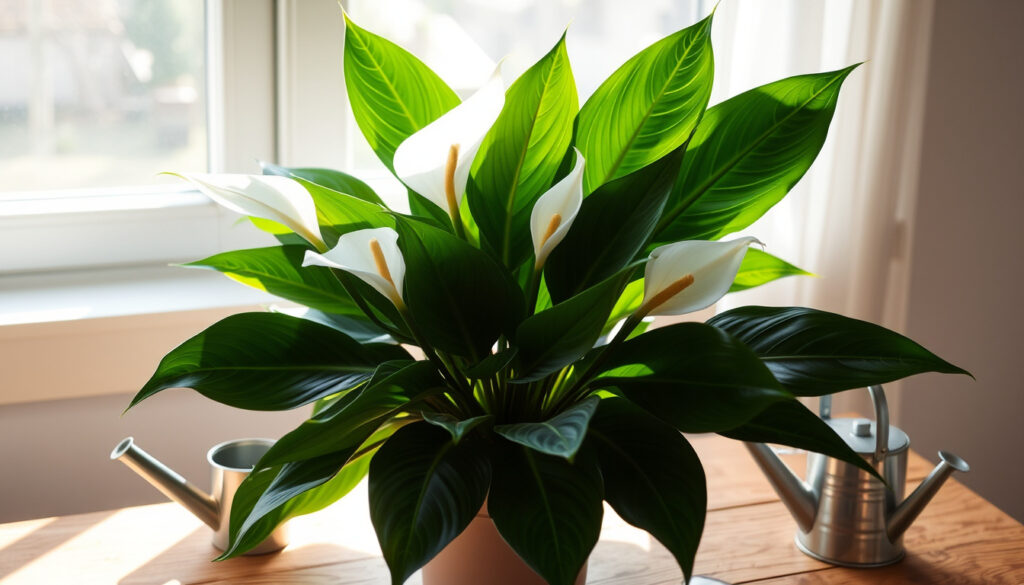
Peace Lily Care: The Complete Guide to Light, Water & Bloom
Anyone who’s brought home a peace lily knows the feeling: that first week it’s perky and pristine, then the leaves start drooping or turning brown at the tips. The good news is that peace lilies are forgiving plants, and with the right balance of light, water, and fertilizer, they can thrive indoors for years.
Botanical name: Spathiphyllum ·
Native to: Tropical Americas and Southeast Asia ·
Light requirement: Indirect bright light ·
Water frequency: Every 1-2 weeks (soil top dry) ·
Toxicity: Toxic to cats and dogs ·
Bloom season: Spring to summer (with proper care)
Quick snapshot
- Peace lilies are not true lilies; they belong to the Araceae family (Wikipedia)
- They improve indoor air quality by removing VOCs like benzene and formaldehyde (NASA Clean Air Study)
- Blooms are triggered by bright indirect light and temperature cues (SDSU Extension university horticulture program)
- Optimal phosphorus ratio for flowering is debated among growers (Flower Shop Network horticultural resource)
- Effect of coffee grounds on soil pH and bloom frequency lacks robust evidence (Flower Shop Network horticultural resource)
- Peace lilies can live 5-10 years indoors with proper care (Flower Shop Network horticultural resource)
- Repot every 2-3 years to refresh soil and prevent root crowding
- Divide overcrowded plants in spring to extend lifespan and create new plants
- Adjust watering schedule seasonally — less in winter, more in growing season
Eight key facts at a glance, one pattern: peace lilies are low-maintenance but sensitive to extremes — too much direct sun, soggy soil, or cold drafts will show up fast in the leaves.
| Attribute | Value |
|---|---|
| Botanical name | Spathiphyllum spp. |
| Common name | Peace Lily |
| Light | Bright, indirect |
| Water | Moderate, soil top dry |
| Humidity | High preferred; mist leaves |
| Temperature | 65-80°F (18-27°C) |
| Toxicity | Toxic to cats, dogs, humans |
| Lifespan | 5-10 years with care |
Where is the best place to put a peace lily?
Light requirements for peace lilies
- Peace lilies thrive in bright, indirect light — an east or north-facing window is ideal, according to SDSU Extension university horticulture program.
- Direct sunlight scorches leaves, causing brown patches (Now and Forever Flowers florist care guide).
- Low light is tolerated, but flowering becomes less reliable (Flower Shop Network horticultural resource).
“Peace lilies do best in bright, indirect light rather than direct sun. An east-facing window or north window provides ideal conditions because it delivers bright, indirect light without scorching the leaves.”
— SDSU Extension, university horticulture program
A peace lily placed in a dim corner will survive but rarely bloom. The owner who wants flowers must prioritize bright indirect light — even if that means moving the plant twice a year as the sun’s angle shifts.
Avoiding direct sunlight and drafts
- South-facing windows are risky unless filtered by a sheer curtain (Leaves and Soul plant care blog).
- Keep peace lilies away from air conditioning vents, radiators, and drafty windows — temperature swings stress the plant.
- SDSU Extension warns that prolonged exposure to temperatures below 55°F can kill the plant.
The implication: placement is the single most consequential decision for a peace lily. Get the light right, and most other problems become manageable.
How should I take care of a peace lily?
Watering schedule and tips
- Water when the top inch of soil feels dry — typically every 1-2 weeks, but frequency varies by environment (Leaves and Soul plant care blog).
- Use room-temperature water that has sat out overnight, recommends SDSU Extension university horticulture program.
- Never let the pot sit in standing water — Scotts Miracle-Gro lawn and garden brand warns this leads to root rot.
- Reduce watering in winter when growth slows; increase during brighter, warmer months (Flower Shop Network horticultural resource).
- Check soil moisture — Insert a finger into the potting mix up to the first knuckle. If the top inch feels dry, it is time to water.
- Water thoroughly — Pour room-temperature water evenly over the soil until it drains from the bottom. Discard any standing water in the saucer to prevent root rot.
- Adjust for season — Water less frequently in winter when growth slows, and increase frequency during the brighter, warmer growing months.
Soil and potting recommendations
- Use a well-draining potting mix — standard indoor potting soil works fine.
- Choose a pot with drainage holes; peace lilies cannot tolerate waterlogged roots.
- Repot every 2-3 years to refresh soil and provide room for root growth.
Fertilizer use and frequency
- Fertilize monthly during spring and summer with a balanced liquid fertilizer (Now and Forever Flowers florist care guide).
- Flower Shop Network horticultural resource recommends a 20-20-20 soluble fertilizer at half-strength.
- Stop fertilizing in fall and winter when the plant rests (Leaves and Soul plant care blog).
Cleaning leaves
- Dust leaves monthly with a damp cloth to improve photosynthesis.
- Avoid leaf-shine products — they clog pores and reduce the plant’s ability to breathe.
How do I get my peace lily to flower again?
Encouraging new blooms
- Bright indirect light is the primary trigger for flowering — SDSU Extension university horticulture program notes that low light reduces bloom frequency.
- Temperature between 65-80°F supports flower development; avoid cold drafts.
- Consistent moisture (not soggy) during the growing season helps initiate buds.
Role of fertilizer and light
- Use a fertilizer higher in phosphorus (e.g., 10-30-10) in early spring to encourage blooms, though Flower Shop Network horticultural resource notes the optimal ratio is debated among growers.
- Monthly feeding during spring and summer promotes healthy growth and more frequent blooms (Now and Forever Flowers florist care guide).
Deadheading spent flowers
- Cut off faded blooms at the base of the stem to redirect energy into new growth.
- Remove yellow or damaged leaves to keep the plant focused on healthy foliage and flowers.
“Peace lily was found to remove benzene, formaldehyde, and other volatile organic compounds from indoor air, making it one of the most effective plants for improving indoor air quality.”
— NASA Clean Air Study (1989)
A peace lily that refuses to bloom is almost always telling you one thing: not enough light. The owner who moves it to a brighter spot and fertilizes lightly in spring will typically see flowers within 6-8 weeks.
The pattern: blooming is a reward for consistency. Owners who nail light and watering through the winter will be repaid with white spathes in spring.
What are the disadvantages of peace lilies?
Toxicity to pets and humans
- Peace lilies contain calcium oxalate crystals, which are toxic if ingested by cats, dogs, or humans (ASPCA Animal Poison Control).
- Symptoms include oral irritation, drooling, vomiting, and difficulty swallowing.
- Keep plants out of reach of pets and small children.
Susceptibility to pests
- Common pests include spider mites and mealybugs, especially in dry indoor air.
- Regular misting and wiping leaves helps prevent infestations.
- Treat infestations early with insecticidal soap or neem oil.
Fungal issues from overwatering
- Overwatering leads to root rot, yellow leaves, and fungal gnats.
- Scotts Miracle-Gro lawn and garden brand emphasizes that peace lilies prefer consistently moist soil — not wet.
- Always check soil moisture before watering; a moisture meter can help beginners.
The catch: the same traits that make peace lilies easy — their tolerance of low light and forgiving watering windows — also make them prone to overcare. The most common killer is kindness in the form of too much water.
How long do potted peace lilies last?
Average lifespan indoors
- With proper care, peace lilies can live 5-10 years indoors (Flower Shop Network horticultural resource).
- Lifespan depends on consistent care — light, water, and fertilizer all play a role.
Signs of aging and rejuvenation
- Older plants may produce fewer flowers and develop leggy growth.
- Divide overcrowded plants in spring to rejuvenate them and create new plants.
- Cut back old, yellowing leaves to encourage fresh growth.
When to repot
- Repot every 2-3 years when roots become crowded or soil breaks down.
- Choose a pot 1-2 inches larger in diameter than the current one.
- Spring is the best time for repotting, just before the growing season begins.
Why this matters: a peace lily is not a disposable plant. The owner who invests in repotting and division every few years can keep the same plant for a decade — longer than many indoor plants survive.
Related reading: Women’s Leather Jackets: Best Styles & Care Tips
leavesandsoul.com, nowandforeverflowers.com, elmdirt.com, scottsmiraclegro.com, youtube.com
Frequently asked questions
How do I save a drooping peace lily?
Drooping usually means the plant is thirsty — water thoroughly and it should perk up within a few hours. If the soil is already wet, drooping may indicate overwatering or root rot; let the soil dry out before watering again.
Should I cut yellow leaves off my peace lily?
Yes. Yellow leaves are often a sign of overwatering, low light, or natural aging. Trim them at the base to keep the plant looking tidy and to redirect energy to healthy growth.
Can peace lilies grow in water only?
Peace lilies can survive in water for a period, but they grow best in soil. In water alone, they may lack the nutrients needed for long-term health and flowering.
How often should I repot a peace lily?
Every 2-3 years, or when roots start growing out of the drainage holes. Spring is the ideal time for repotting.
Why are the tips of my peace lily turning brown?
Brown tips are usually caused by dry air, fluoride in tap water, or inconsistent watering. Increase humidity, use filtered water, and keep the soil evenly moist.
Do peace lilies need direct sunlight?
No. Direct sunlight scorches their leaves. They thrive in bright, indirect light — an east or north-facing window is ideal.
Is peace lily safe for pets?
No. Peace lilies contain calcium oxalate crystals that are toxic to cats and dogs if ingested. Symptoms include drooling, vomiting, and oral irritation. Keep the plant out of reach.
More related posts
 Interest Rate Cuts Australia: RBA Forecasts & Predictions
 Carlos Ulberg: Biography, Ethnicity, Injury, Pay, and UFC Record
 Diane Ladd Death Cause: Obituary, Family & Career
 Bronson Xerri: NRL Doping Ban, Dummy Spit, OnlyFans
 Lincoln Lewis: Home and Away Actor to Sports Presenter
 Greg Page Wiggles: Health Crisis, Departure & Comeback
 Saint Mary MacKillop: Biography, Miracles, and Legacy
 Sienna Spiro Biography: Age, Ethnicity, Family & More