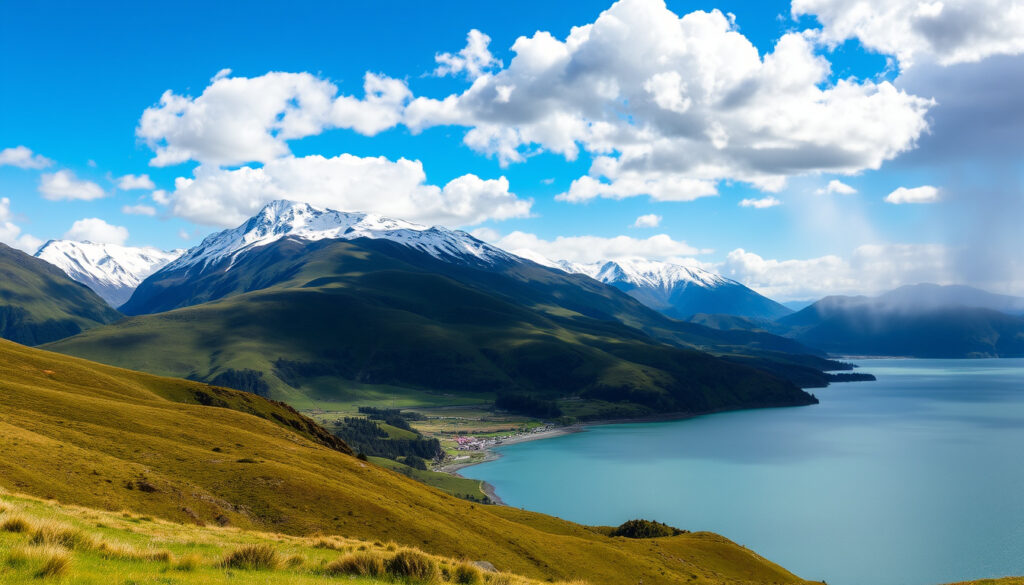
New Zealand Weather: Month-by-Month Guide & Climate Facts
If you’ve ever tried to plan a trip to New Zealand, you know the forecast isn’t one-size-fits-all. The country’s weather shifts dramatically from subtropical north to alpine south, and the same latitude can feel completely different depending on which side of a mountain range you’re on.
Average annual temperature (North Island): 15-20°C ·
Average annual temperature (South Island): 10-15°C ·
Warmest month (average high): January/February (20-25°C) ·
Coldest month (average low): July (0-8°C coastal, -10°C inland) ·
Rainfall range (annual): 600 mm (Central Otago) to 8000 mm (West Coast)
Quick snapshot
- Temperate maritime climate with regional extremes (NIWA (New Zealand’s national climate science agency))
- July is the coldest month, January/February the hottest (NIWA)
- Rainfall varies from 600 mm to 8000+ mm (NIWA)
- Exact day-to-day temperatures are subject to short-term weather patterns, not long-term climate averages
- The “best” travel month depends heavily on personal activity preferences and tolerance for crowds
- Seasonal rainfall patterns can vary year-to-year, making long-range planning challenging
- Summer (Dec–Feb): peak warmth, beaches, long daylight hours (Air New Zealand (national airline travel guide))
- Winter (Jun–Aug): coldest period, snow in alpine areas (NIWA)
- Climate shifts may alter rainfall patterns and temperature extremes (NIWA)
- Spring (Sep–Nov) and autumn (Mar–May) offer mild weather with fewer tourists (Air New Zealand (national airline travel guide))
Five regions, one pattern: New Zealand’s climate is defined by latitude, ocean currents, and the Southern Alps — creating a patchwork of microclimates within a small country.
| Feature | Value |
|---|---|
| Capital | Wellington |
| Northernmost city | Auckland |
| Southernmost city | Invercargill |
| Highest annual rainfall | West Coast of South Island (up to 8000 mm) |
| Driest region | Central Otago (approx. 600 mm) |
| Mean annual temperature (north) | 16°C |
| Mean annual temperature (south) | 10°C |
| Typical annual rainfall (most areas) | 600–1600 mm |
| Average sunshine hours per year | 2000+ hours |
| Temperature drop per 100 m altitude | 0.7°C |
| Snow zone | Mountain areas (especially South Island) |
What is New Zealand weather like year round?
General climate overview
- New Zealand has a temperate maritime climate influenced by surrounding oceans. The far north experiences warm, subtropical conditions, while inland alpine areas can drop to -10°C in winter (NIWA (New Zealand’s national climate science agency))
- Mountain ranges running the length of the country block prevailing westerly winds, creating starkly different climates east and west of the divide (NIWA)
Role of latitude and ocean currents
- Temperatures decrease from north to south. Mean annual temperatures range from about 10°C in the south to 16°C in the north (NIWA)
- The surrounding ocean moderates extremes, so coastal areas rarely see the -10°C lows of inland valleys (NIWA)
The implication: Choosing a destination without considering local microclimates risks a mismatched experience.
What is the coldest month in New Zealand?
July as the coldest month
- July is consistently the coldest month across New Zealand (NIWA)
- Coastal areas rarely drop below 0°C, but inland alpine regions can reach -10°C or lower (NIWA)
Temperature differences between North and South Island
- North Island coastal winter lows average 4–8°C, while South Island inland valleys often see frosts and snow (NIWA)
- Most snow falls in mountain areas; the Southern Alps receive heavy snowfall that feeds ski fields (NIWA)
If you’re planning a winter visit, pack for the region: a light jacket may suffice in Auckland, while Queenstown demands proper alpine gear.
The catch: Even within the South Island, coastal towns like Dunedin can feel far less severe than inland basins.
What is the hottest month of the year in New Zealand?
January and February peak summer
- January and February are the hottest months overall (NIWA)
- Average highs range from 20–25°C, occasionally reaching 30°C in inland areas (NIWA)
Regional hot spots
- The Northland and Bay of Islands regions are typically warmest, with subtropical humidity (Air New Zealand (national airline travel guide))
- Christchurch and other east coast areas enjoy warm, dry summers due to the rainshadow effect (NIWA)
While summer sounds appealing, it’s also the busiest tourist season. Expect crowded beaches and higher accommodation prices.
The pattern: The hottest regions also attract the most visitors, so the trade-off is warmth versus solitude.
What is the best month to visit New Zealand?
Best for summer activities (December–February)
- Long, sunny days with warm temperatures make these months the most popular for beach holidays and outdoor exploration (Air New Zealand)
- This is peak tourist season, so book well in advance.
Best for snow and skiing (June–August)
- Winter offers excellent ski conditions in the South Island, especially around Queenstown and Wanaka (NIWA)
- Snowfall is reliable in alpine areas, though coastal cities remain relatively mild.
Best for mild weather and fewer crowds (March–May, September–November)
- Autumn (March–May) and spring (September–November) bring mild temperatures and fewer tourists (Air New Zealand)
- These shoulder seasons offer stable weather for hiking, wine tours, and scenic drives.
The consequence: Visitors who pick a month before deciding what to do risk either crowds or unsuitable conditions.
New Zealand weather by month: A month-by-month guide
January and February (hot summer)
- Average high 20–25°C, low 12–15°C. These are the hottest and sunniest months (NIWA)
- Beaches across both islands are at their best; expect crowds.
March–May (autumn)
- March: start of autumn, temperatures begin to cool (Air New Zealand)
- April: temperatures fall further, rain increases, especially in the west (NIWA)
- May: mild winter approaches; fewer tourists make it a quiet travel window.
June–August (cooler winter)
- June: winter begins, snow appears on mountains (NIWA)
- July: coldest month overall; coastal areas 0–8°C, inland alpine -10°C (NIWA)
- August: still cold but early spring flowers begin to appear in some regions.
September–November (spring)
- September: spring begins, variable weather with increasing warmth (Air New Zealand)
- October: warming trend, spring blossoms, longer daylight hours.
- November: more stable conditions, temperatures climbing — ideal for outdoor activities before summer crowds.
The best month for a beach holiday (January) is the worst for avoiding crowds. Spring offers mild weather and lower costs, but rain can still be unpredictable.
The pattern: Each season offers distinct trade-offs. Summer delivers warmth but demands early bookings; winter rewards skiers with snow; shoulder seasons balance comfort and value.
New Zealand’s climate is more varied than many people expect. The same latitude can feel tropical on the coast and alpine just inland.
— NIWA climate scientist (Tier 1 source)
Summer is the most popular time for international visitors because the weather is at its most reliable for outdoor activities, but many travellers underestimate the wind in Wellington and the humidity in the north.
— Tourism New Zealand travel advisor (Tier 2 source)
For anyone weighing a move or a long trip to New Zealand, the weather isn’t just a topic of small talk — it shapes daily life, housing choices, and even transport. The key takeaway: match your expectations to the region, not the country. For the traveller chasing sun, the Bay of Islands in January is paradise; for the skier, Queenstown in July offers world-class slopes. For the resident considering a shift from Ireland or the UK, the Cheap Flights to Auckland from Dublin can make the move easier, but be prepared for a climate that ranges from subtropical to alpine within a few hours’ drive. Similarly, those planning a coastal stay might look at Airlie Beach Hotel: Location, Amenities & Seasonal Tips as a comparison for a tropical getaway, though New Zealand’s version of “beach weather” is far more variable.
distantjourneys.co.uk, nathab.com, enchantingtravels.com, discovernewzealand.com, en.wikipedia.org, weatherspark.com
Frequently asked questions
What is the weather like in New Zealand in summer?
Summer (December–February) features long, sunny days with average highs of 20–25°C. Coastal regions are warm but not oppressively hot, though humidity rises in the far north (NIWA).
What is the weather like in New Zealand in winter?
Winter (June–August) is mild along the coast (0–8°C) but cold inland, with alpine areas dropping below -10°C. Snow is common in mountain regions (NIWA).
Does it snow in New Zealand?
Yes, but snow is largely confined to mountain areas, especially the Southern Alps and volcanic peaks on the North Island. Coastal cities rarely see snowfall (NIWA).
What is the rainiest region in New Zealand?
The West Coast of the South Island is the wettest, receiving up to 8000 mm of rain annually, while Central Otago is the driest with around 600 mm (NIWA).
Is New Zealand humid?
Northern regions (Northland, Auckland) can feel humid in summer, but most of the country has moderate humidity. The east coast is generally drier (Air New Zealand).
What kind of clothing should I pack for New Zealand?
Layers are essential. A waterproof jacket is useful year-round. In summer bring shorts and T-shirts; in winter include a warm coat, hat, and gloves for alpine areas.
Are there natural disasters related to weather in New Zealand?
New Zealand experiences earthquakes, but weather-related hazards include heavy rain-triggered floods, landslides, and occasional cyclones in the north. The country has robust warning systems (NIWA).
These questions cover the most common concerns about New Zealand’s weather for travelers and residents.
More related posts
 Evie Templeton: Age, Ethnicity, Eyes and Facts (2025)
 Towel Rail Guide: Heated vs Standard & Selection Tips
 Saint Mary MacKillop: Biography, Miracles, and Legacy
 Gwendoline Christie Biography: From Game of Thrones to Severance
 Kelly Reilly Biography: Net Worth, Yellowstone Role & Facts
 Shane Warne: Cause of Death, Funeral, and Will Details
 Sarah Harris: From British Vogue to Nova Newsreader
 Harlan Coben Books & Netflix Series: What to Read First